STEM OPT → H-1B: Your First 36 Months as an F-1 STEM Career
The Entry-track playbook for F-1 STEM students on OPT: how to build your first US resume, signal sponsorship-readiness without US work history, and use the 36-month F-1 → OPT → STEM extension → H-1B lottery runway. Written for students on OPT or approaching OPT filing their first H-1B.
Published
May 4, 2026
You are graduating in 6 months. Your peers already have offers. You have none, because most US employers see your I-20 and quietly filter you out — not because you are less qualified, but because they do not know how to explain to a hiring manager that you cost $5,000–12,000 in total sponsorship costs (attorney fees + USCIS filing fees) and will need sponsorship in year three.
This is the F-1 STEM student's opening problem. It looks like a rejection problem. It is actually a resume problem — the file that reaches the hiring manager needs to answer three questions before your qualifications are even considered:
- Are you legal to work today?
- For how long, without any action from us?
- What is our exposure if we want to keep you past that?
The 12 + 24 + lottery mechanics of F-1 → OPT → STEM OPT → H-1B give you 36 months to get from "expensive foreign student" to "someone we already hired and can't easily lose." Every resume you send during those 36 months should be tuned to the visa question of that specific stage.
This guide is written for F-1 STEM students on OPT or approaching OPT — building their first US resume, running their first US job search, and filing their first H-1B. If you already have a full-time US role and are switching employers mid-STEM-extension, see H-1B Resume for Indian Engineers for the mid-career filing playbook.
OPT Basics — Everything an F-1 Student Actually Needs to Know
Let's anchor the rules first, because the resume strategy below depends on knowing exactly which visa stage you are in.
F-1 status — you are here now, legally studying on a student visa. Your DSO (Designated School Official) at your university's International Student Office is your first stop for everything below.
Standard OPT gives you up to 12 months of work authorization in a field directly related to your degree, starting after you graduate (post-completion) or optionally during your final year (pre-completion, but this eats into the 12 months). You apply through USCIS Form I-765, and the EAD card that authorizes you to work typically arrives 2–5 months later — often longer with paper filing or USCIS delays (7+ months has been common). Premium processing ($1,685, guaranteed adjudication within 30 business days) is available for OPT and STEM extension I-765 filings.
STEM OPT Extension adds 24 months on top of standard OPT, but only if three conditions are met:
- Your degree is on the official DHS STEM Designated Degree Program List. Not every "tech-adjacent" major qualifies — verify your CIP code against the DHS list before assuming.
- Your employer is enrolled in E-Verify. Non-negotiable. Even the most enthusiastic startup cannot sponsor your STEM extension if they haven't enrolled.
- You file a Form I-983 training plan with your DSO, and you + your employer commit to formal training goals with evaluations.
Practical timeline (print this):
| Stage | Duration | Notes |
|---|---|---|
| F-1 in school | Until graduation | CPT allowed if internship counts for credit |
| Grace period after graduation | 60 days | Must apply for OPT during this window |
| Post-completion OPT | Up to 12 months | Starts on EAD start date |
| STEM Extension | Additional 24 months | Apply at least 90 days before standard OPT expires |
| Cap-Gap (if H-1B picked) | Up to ~6 months | Bridges OPT expiration to Oct 1 H-1B start |
| Total potential authorized | ~36 months | Three H-1B lottery attempts is the realistic upside |
Three lottery cycles is what STEM OPT really buys you. Since the beneficiary-centric rules were introduced in 2024 (each unique person enters once regardless of how many employers register), the lottery selection rate has settled around ~29–35% per cycle — USCIS selected ~29% in FY 2025 and 35.3% (118,660 of 336,153 unique beneficiaries) in FY 2026 to fill the 85,000 annual quota. Three attempts give a meaningfully higher cumulative probability — but only if you spend those 36 months at sponsoring employers.
Two employer-side facts to encode into your job search from day one:
- E-Verify is the filter that matters. If you only target E-Verify employers, you preserve the STEM extension door. Filter your job search ruthlessly.
- H-1B sponsorship history is observable. USCIS publishes the H-1B Employer Data Hub. Companies that have never filed an H-1B for an engineering role are unlikely to start with you. Use the data, not their careers-page promises.
The Entry Resume: From Student to First US Job
Your first resume as an F-1 student has to do something no US-native peer's resume needs to do: prove you are worth hiring despite the visa complication. The bar is not "as good as a US peer." It is "so good the hiring manager decides the sponsorship is worth it."
Three concrete changes make your student resume competitive at Stage A (OPT month 0-9):
1. Lead with the Work Authorization Line
The single most important sentence on an international student resume is the one most people never write. Put it in the header, right below your name and contact info.
Weak: "Visa Status: F-1 OPT until June 2027"
Recruiters have to interpret "F-1 OPT" and guess whether you are a sponsorship risk. They are not immigration lawyers. Ambiguous resumes lose.
Strong: "Work Authorization: F-1 STEM OPT — authorized to work in the US through June 2029. No sponsorship required for the next 24 months."
The "no sponsorship required for X months" half is the phrase recruiters search for. You are giving them the conclusion they need: hire-able today, decision required in 2029. That single line moves your resume from the "sponsorship risk" pile to the "safe hire" pile.
2. Quantify Student Work Like It's Real Work
Your competitor with 3 years of US industry experience has bullets like "Reduced deploy time from 45 min to 8 min across 12 services." You don't have that yet. But you DO have:
- Class projects with measurable outcomes — "Built a Flask + PostgreSQL grading tool used by 3 professors and 240 students across 2 semesters."
- Teaching Assistant or Research Assistant work — "TA'd Intro to Data Structures for 4 semesters (180 students total); designed weekly problem sets adopted for 2026 curriculum."
- Hackathon results — "1st place, 200-team Google DevFest hackathon: built React + Firebase carbon-tracking app in 24 hours, 400 downloads in first week."
- Open-source contributions — "Merged 7 PRs into the pandas project (data validation edge cases); 1 PR referenced in changelog."
- Internship metrics — "Automated Slack ops reporting during summer internship at Rappi (Colombia); cut manager's weekly reporting time from 3 hours to 20 minutes."
Recruiters are forgiving about lack of full-time US work history in Stage A. They are not forgiving about vague projects with no numbers. See Entry-Level Resume With No US Experience for the full playbook.
3. Use US-Standard Section Order
Name + Contact + Work Authorization Line(top)Summary(2-3 lines: "Recent M.S. Computer Science graduate specializing in distributed systems, seeking Senior Software Engineer roles at E-Verify-enrolled companies. F-1 STEM OPT authorized through 2029.")Education(still at top for recent grads — flips below Experience after ~2 years post-graduation, US convention)Technical Skills(grouped: Languages / Frameworks / Cloud / Tools)Experience(internships, TA/RA, part-time roles — reverse chronological)Projects(below Experience — 3-5 substantive projects with metrics)Awards / Publications(if any)
Common F-1 student mistakes:
- Personal photo (US convention: no photo)
- Date of birth or nationality (US convention: no personal details)
- "Objective" section instead of "Summary" (Objective is 1990s-style)
- Non-Latin fonts that break parsing (see What is ATS in 2026 checklist)
Sponsorship Signaling for Someone With No US Work History
This is the section every entry-level guide skips, and it is where most F-1 offers actually die.
The recruiter reading your resume in month 3 of OPT is asking themselves: "If I hire this person, will my sponsorship committee approve them at H-1B time in 30 months?"
You cannot lie about needing sponsorship. But you can make the sponsorship path look easier by signaling:
Signal 1 — You are on the STEM extension track (not just standard OPT). STEM extension gives the employer 24 additional months to justify sponsorship. Regular OPT gives them 12. State it explicitly: "F-1 STEM OPT (extension-eligible)" — even if you have not applied yet.
Signal 2 — Your intended employer type matches sponsoring companies. If your resume says "Seeking full-stack engineering roles at US-based fintech startups," that reads generic. If it says "Seeking full-stack roles at H-1B-sponsoring, E-Verify-enrolled companies with STEM extension track record (e.g., Stripe, Ramp, Plaid tier)," it reads intentional.
Signal 3 — Your cover letter or LinkedIn About mentions the STEM-extension path. Something like: "Currently on F-1 STEM OPT, planning to file H-1B in the FY2028 cap season. Would welcome the chance to discuss timeline early." Blunt is good. Ambiguity kills sponsorship conversations before they start.
Signal 4 — Your degree code maps to sponsored fields. If your CIP code is unambiguously STEM (Computer Science, Electrical Engineering, Data Science, Biomedical Engineering), name the CIP category explicitly on the resume: "M.S. Computer Science (CIP 11.0701 — STEM Designated)."
5 Common Entry-Level F-1 Failure Modes
From reviewing F-1 STEM student resumes across ~200 US job searches, these five patterns appear over and over:
-
Applying to non-E-Verify employers. They cannot sponsor your STEM extension. Even if they hire you for standard OPT, you lose 24 months of runway. Filter by E-Verify status FIRST, then by role fit.
-
Not naming the sponsorship path. Silence reads as "will need sponsorship soon and hasn't planned it out." Explicit reads as "has planned this out and knows the timeline."
-
Padding education with weak coursework. "Data Structures, Algorithms, Operating Systems" doesn't differentiate you from every other CS grad. Replace with project-based coursework proof: "Coursework: distributed systems (built a Raft consensus implementation as final project); ML (Kaggle Titanic top 5%)."
-
Under-quantifying pre-professional work. "Volunteered at student club" is invisible. "Led Google Developer Student Club chapter (95 members) at NUS; grew from 30 members through weekly tech workshop series" is a resume line.
-
Applying only to Big Tech. Big Tech's H-1B lottery success rate is one thing; the interview funnel is another. Mid-size E-Verify tech companies (Series B to Series D startups, plus mid-market SaaS) have higher first-round conversion rates and often more sponsorship willingness per role.
Networking & Referrals: Entry's Highest-Leverage Move
For F-1 students specifically, referrals move the needle more than any resume optimization.
Why: Recruiters at H-1B sponsoring companies pattern-match to look for referrals from existing employees when evaluating international candidates. A referral shortcuts the sponsorship-risk question — "if [Employee] vouches, I'll interview."
Where to find referrals:
- University alumni working at target companies — LinkedIn "Alumni" filter on your school page. Reach out with a specific ask: "I'm a current M.S. student targeting SWE roles at [Company]. I noticed you're on the platform team. Would you be open to a 20-minute chat about your team's hiring process?" Referrals often follow after the conversation.
- Career fair conversations, followed up in writing — most career fair interactions never convert because students don't follow up. A 3-sentence email 48 hours later ("Really appreciated learning about the ML platform team; here's my resume — would love to interview when the role opens") converts at 5-10x rate.
- Faculty introductions — your advisor and professors often have industry connections. Ask specifically: "Do you know anyone at [Company X] I could talk to about SWE roles?"
- Alumni Slack/Discord communities — many top US CS programs have alumni-only Slack channels with active referral culture.
The specific tactic for F-1 students: mention your visa status early, once, in a neutral tone. "I'm on F-1 STEM OPT with 30 months of work authorization + STEM extension track. Would love to discuss whether the team has sponsored H-1B in the past." This filters out companies that cannot sponsor and accelerates conversations with those that can.
The 36-Month Runway Dashboard
Print this. Tape it to your monitor.
| Month | Visa Stage | Resume Action | Job Search Action |
|---|---|---|---|
| -3 to 0 (last semester) | F-1 / preparing OPT | Build "Stage A" entry resume with student-work quantification | Target E-Verify employers only; hit alumni network hard |
| 1-3 (OPT start) | Post-completion OPT | Add "F-1 OPT — no sponsorship required 24-36 months" line | 30-50 applications per week; referral-first |
| 4-9 (settled) | OPT | First bullet rewrite with real work metrics; update LinkedIn | First salary-bar interviews |
| 10-12 (inflection) | Approaching OPT expiration | Confirm employer enrolled in E-Verify; if not, switch by month 11 | File I-983 STEM extension application |
| 13-22 (STEM extension) | STEM OPT | Add "Selected Achievements" section (3 lines) above Experience | Begin networking with H-1B sponsors' hiring managers |
| 22-26 (H-1B prep year) | STEM OPT | Optimize resume for cap-subject sponsors | Internal transfer to sponsor, or external move to one |
| 27-30 (registration) | STEM OPT | Mention cap-gap eligibility on resume | Confirm employer files H-1B registration in March |
| 31-36 (post-lottery) | Cap-gap or transitioning | If selected: shift to "H-1B approved" header; if not: pivot to 2nd lottery cycle | Explore O-1, L-1, or country-specific options if not selected |
Two under-rated checkpoints:
- Month 11 is the most critical. If your current employer is not enrolled in E-Verify (or is but unwilling to sponsor STEM extension), you must switch before standard OPT expires. Switching during the grace period is a disaster scenario.
- Selected Achievements section belongs only in Stage B (month 13+). Adding it in month 2 reads as inflated. Adding it in month 14 reads as confident.
See Bullet Creator in Action — 3 Steps for F-1 Students
Building your master library of impact bullets once — during your last semester or first months on OPT — is what makes the entire 36-month runway manageable. Here's what the Bullet Creator flow looks like for a new grad:
Step 1 · Select the Metric Type
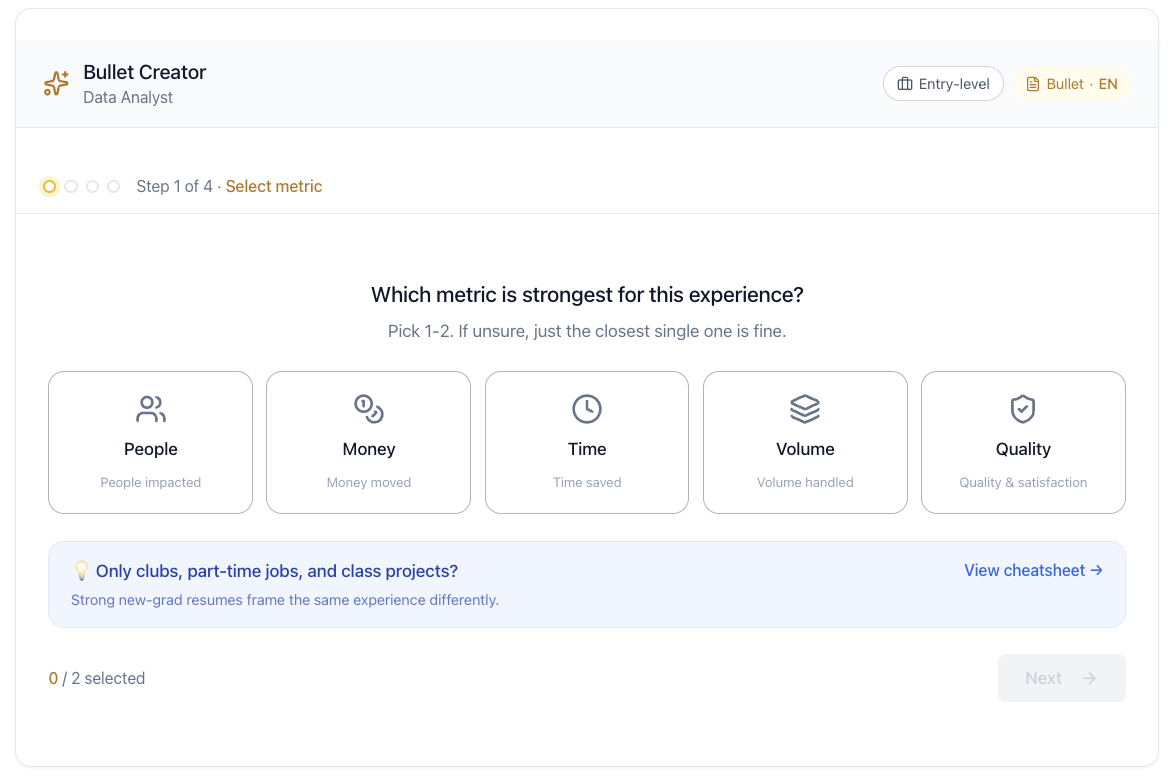
Choose 1–2 of PMTVQ 5 axes (People, Money, Time, Volume, Quality). For student work, Time and Volume are usually the easiest anchors — how many students used your project, how many hours you saved in a workflow.
Step 2 · AI Interview
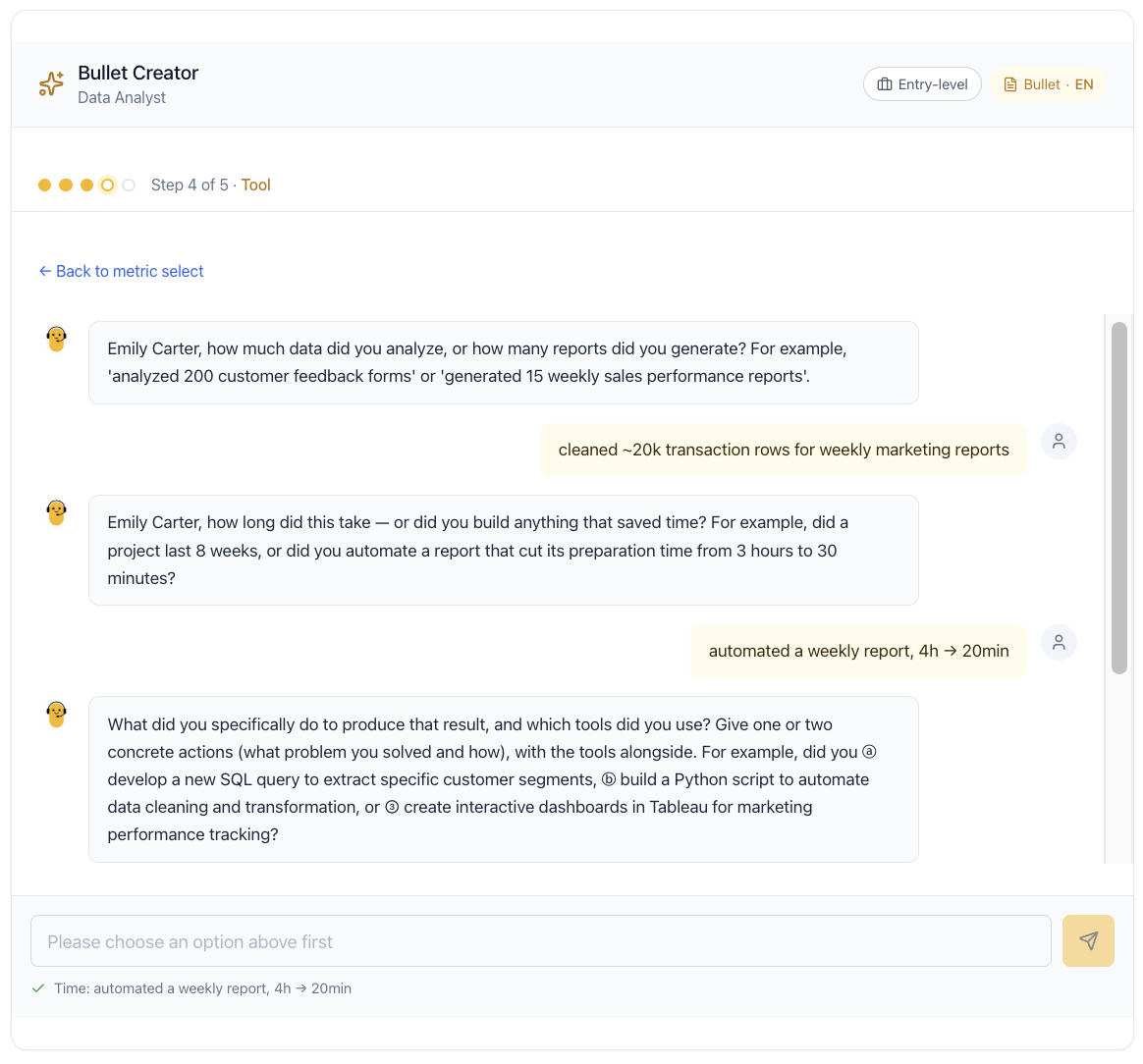
Answer in your native language — Hindi, Spanish, Mandarin, Portuguese, Vietnamese, Arabic, or English. The AI extracts SKILL · TOOL · GOAL · IMPACT structure from your answers and preserves the actual numbers you input (no fabrication of student-work metrics).
Step 3 · US-Ready Impact Bullet
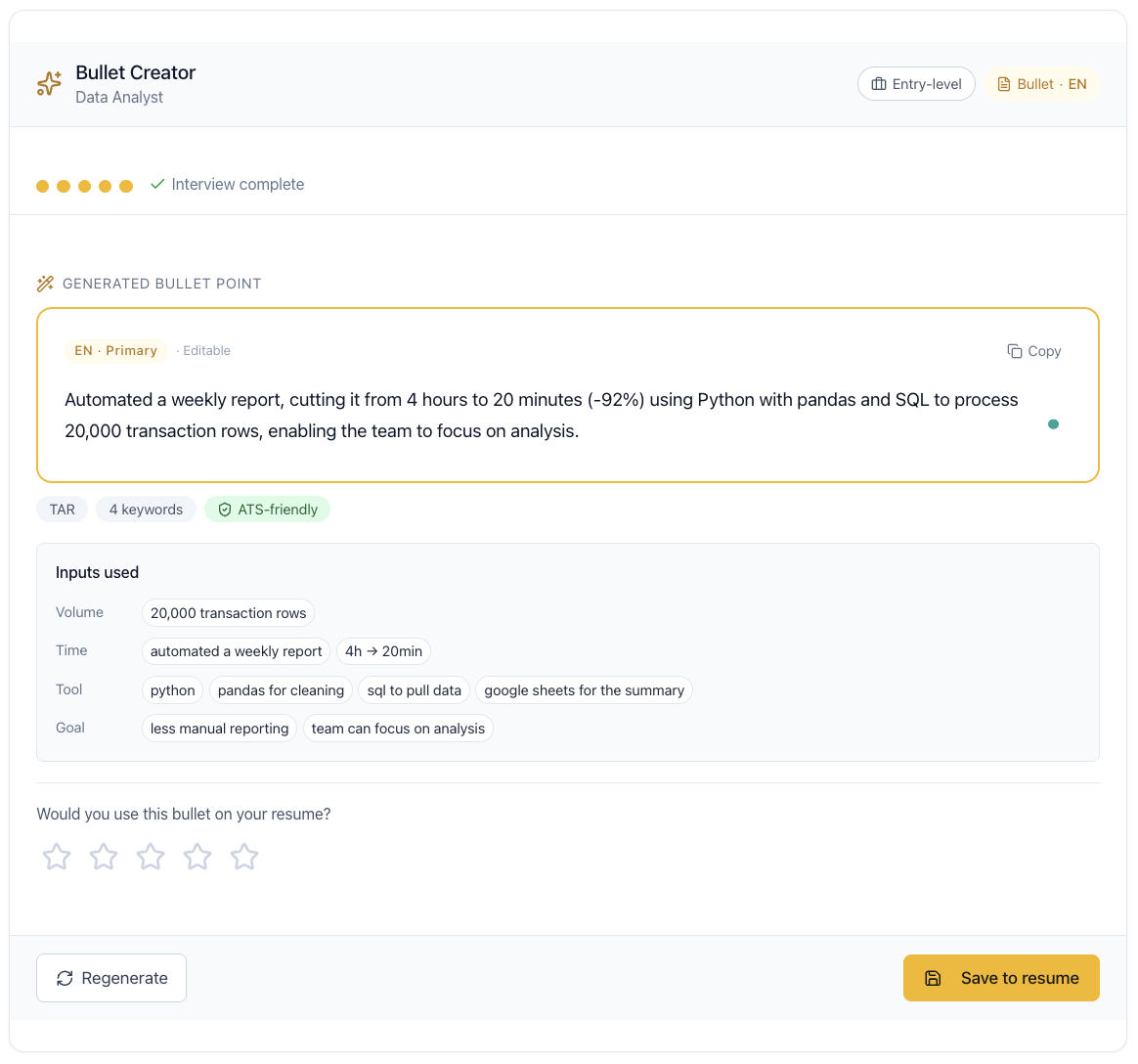
Your input numbers are preserved 1:1. The output reads to a US recruiter as native English while remaining faithful to what you actually built — the master bullet library that JD Clipper, Resume Generator, and Cover Letter Generator all reuse across your OPT → STEM extension → H-1B arc.
Start with Bullet Creator — build the master library once during your last semester, reuse it across every application for the next 36 months.
Where This Fits in Your Career Journey
This is an Entry-track article in the International Career Series — the first-job starting point for F-1 STEM students building a US career.
Foundational reading (before you dive in):
- What is ATS in 2026 — the gate every one of your 3+ resumes has to clear.
- ATS 7 Rules 2026 — the practical rulebook that turns ATS theory into concrete edits.
Entry-track companions (same F-1 / first-job audience):
- H-1B Resume for Indian Engineers — First-Time Filer — the regional deep-dive that pairs with this playbook.
- Entry-Level Resume With No US Experience — the fullest playbook on quantifying student projects, internships, TA work.
Complete the Toolkit — 3 More Products That Reuse Your Master Library
Once your Bullet Creator master library is built, three more Bullets tools automate the rest of the 36-month runway:
- JD Clipper (Chrome extension) — Clips any job posting from LinkedIn, Indeed, Greenhouse, or Lever in one click. Auto-extracts the ATS keywords and — importantly for F-1 students — flags whether the company appears in H-1B sponsorship databases.
- Resume Generator — Takes your master bullets + a clipped JD and reassembles a Stage A, B, or C resume in STAR/TAR format. The same student projects you quantified once become 30 tailored applications without rewriting.
- Cover Letter Generator — Turns the same master library into a 3-paragraph cover letter with the sponsorship signal language built in — no more "How do I bring up my visa without scaring them?" every time.
For F-1 STEM students specifically: the toolkit is what makes the 36-month runway manageable across every application, employer switch, and lottery cycle.
Sources: USCIS H-1B Employer Data Hub, USCIS FY 2025 & FY 2026 H-1B cap selection data (via Fragomen · Ogletree · USCIS press releases), USCIS beneficiary-centric H-1B registration rules (2024), DHS STEM Designated Degree Program List, USCIS Form I-907 premium processing fee schedule ($1,685), Jobscan 2025 ATS Usage Report, F-1/OPT/STEM extension mechanics from US ICE SEVP official documentation.
Tagged with
Comments
0 comments
No comments yet. Be the first to comment!
Ready to build your resume?
Bullets — Tailored resumes and cover letters, faster.