ATS Resume: 7 Rules That Get Yours Past the Filter (2026 Edition)
Same person, same experience — but callback rate dropped after 2025? You didn't get weaker; the ATS jumped a generation. ATS 2.0 reads context, not keywords. Seven rules that keep your resume through the filter in 2026, with Before → After examples for each and the specific traps international applicants trip on.
Published
Jun 22, 2026

Same experience, same qualifications — but the callback rate that worked in 2024 quietly dropped after 2025? You probably didn't get weaker. The ATS jumped a generation. The 2018-era resume rules that felt like gospel (dense keyword lists, "Objective" at top, safe generic language) actively hurt your file in the 2026 ATS 2.0 world.
New to ATS entirely? Read What is ATS in 2026 first. This piece assumes you know the basics — what changed, and the seven rules that follow from those changes.
ATS 1.0 → ATS 2.0 · The Generational Shift
| ATS 1.0 (pre-2024) | ATS 2.0 (2025+) | |
|---|---|---|
| Matching | Exact keyword match | Semantic-aware (context + related terms) |
| Synonyms | Missed entirely | Recognized (led ↔ managed, built ↔ developed) |
| Keyword stuffing | Ranked higher | Flagged as unnatural, penalized |
| Review unit | Single line | Bullet + full-resume context together |
The takeaway: memorizing and inserting JD keywords isn't the game anymore. How each keyword sits alongside a specific outcome determines whether the ATS surfaces you and whether the recruiter's 7-second scan holds their attention. Every rule below flows from this shift.
The 7 Rules
#1 · Single-column layout only
Modern deployments of Workday, Greenhouse, Lever, and iCIMS parse most reliably when the resume is a single column, top-to-bottom. Two-column layouts, sidebars, and text boxes are the leading cause of parsing failures — your name gets omitted, dates attach to the wrong role, or a skills sidebar bleeds into your Experience section.
Small design touches that pass ATS but hurt readability: icons in place of section labels, skill bars, decorative dividers. Strip them.
#2 · Value Proposition Summary at the top, not "Objective"
The top 4-6 lines set the entire resume's tone for both the ATS parser and the recruiter's 7-second scan. "Objective" statements ("Looking for a challenging position to grow…") are dead — they signal a candidate who hasn't defined what they bring.
- Weak: "Looking for a challenging position to grow my product management career."
- Strong: "Senior PM, 7 years scaling B2B SaaS from $2M to $30M ARR through PLG motion; shipped activation and pricing features across US and EU markets."
Lead with role + years + one specific outcome + market context. Recruiter knows in 3 seconds whether to read further.
#3 · The 70% metric rule
At least two-thirds of your Experience bullets should carry a real number — %, $, multiplier, time, count. This is what ATS 2.0's semantic matching latches onto and what recruiters actually read in the 7-second scan.
- Weak: "Responsible for managing marketing campaigns across multiple channels."
- Strong: "Reduced CAC 32% ($48 → $33) across 12 paid channels by rebuilding GA4 attribution over 6 weeks."
If a bullet has no number, either surface one via the PMTVQ framework or cut the bullet. Un-quantified bullets are dead weight in 2026.
Struggling to find numbers? Deep dive: Hidden Metrics by Job Role · Bullet Quantification 101.
#4 · AI tools listed with outcomes, not as standalone skills
Microsoft Office as a skill was already dated by 2020. In 2026, listing ChatGPT / Claude / Copilot / Perplexity as standalone Skills carries the same "obvious baseline" energy — everyone has them. The new differentiator is what you built with those tools and what changed as a result.
- Weak:
Skills: ChatGPT, Claude, Perplexity, Copilot - Strong:
Built AI research workflow (Claude + Perplexity) that cut competitive analysis from 8 hours/week to 90 minutes; scaled to 3 other analysts.
The rule: name the tool + the workflow you built + the measurable time or output change.
#5 · Font, length, and file format
Tactical but non-negotiable:
- Font: Garamond, Arial, Helvetica, or Calibri. 10-12pt for body, 12-14pt for headers. Times New Roman parses fine but reads dated in 2026.
- Margins: 1 inch on all sides (0.75 inch minimum if you must compress).
- Length: 1 page for < 10 years experience, 2 pages for 10+ years. Never 3 pages — even a senior IC or VP fits in 2 tight pages.
- File: text-based PDF as default; DOCX only when the JD explicitly asks. Legacy parsers handle text PDFs cleanly in 2026, and the real DOCX risk is font rendering (a Mac-built DOCX can break in Windows Word).
- No photo for applications to US, UK, Canada, Australia, EU markets — photo triggers discrimination-liability filters and, in the EU, automatic GDPR masking.
Quick test: highlight a sentence in your PDF and copy-paste it. If it comes out as text, it's parseable. If you get garbled characters or nothing, it's an image PDF — re-export from source.
#6 · Hyper-Personalization · 5-10 apps beats 30 blast
The 2026 arithmetic: applying to 30 companies with the same resume produces roughly the same shortlist volume as 5-10 companies with resumes tailored per JD — but with 4-6× less pipeline quality. Hyper-Personalization is the shift from "one master resume, everywhere" to "one master library, per-JD variant."
What to tailor per company:
- Job title in the header (match the JD's exact phrasing when honest)
- Summary (adjust the specific outcome and market context to align with the JD)
- Top 3 bullets of your most recent role (surface metrics that map to the JD's priorities)
- Skills section order and selection (JD's must-haves surface first)
Everything else stays as your master. This is what makes the 30-application workload actually sustainable — you're editing 20% per application, not rewriting the whole file.
#7 · Section hierarchy · Hard Skills > Education > Titles > Soft Skills
Order the resume so the ATS surfaces you and the recruiter's 7-second scan lands on your strongest signal first:
Standard section order: Contact → Summary → Skills → Experience → Education → (Certifications / Publications / Volunteering)
For technical, product, design, and data roles, Skills belongs above Experience so that the ATS keyword match lands first. Education-first ordering is a legacy pattern from academic contexts and hurts 90% of the professional roles you'd apply to in US/UK/CA/AU/EU.
For 10+ years experience: Skills can move below Experience, since your Experience is now the primary signal — but the section headers themselves should stay in the standard order the ATS recognizes.
Beyond the 7 Rules · Three Tactical Notes
Boolean search awareness. Recruiters don't run a "70% match score" — that's a Jobscan/Resume Worded marketing number, not what actually happens in the ATS. Recruiters run Boolean searches like (Python OR Java) AND AWS AND "CI/CD". Every must-have you don't include, in context, in a real bullet, drops you out of that search. Split JDs into must-have vs nice-to-have; ensure every must-have you actually possess appears in a bullet.
Descriptor lines for lesser-known employers and schools. Global applicants especially: US/UK/CA/AU/EU recruiters won't recognize Tata Consultancy Services (TCS), Wipro, Infosys, Meituan, Rappi, MTN, or Ateneo — even though these are massive firms/schools regionally. Add one descriptor line: Tata Consultancy Services (TCS) — India's largest IT services firm, 600,000+ employees. Skip descriptors for Google, Meta, Stanford, Oxford — those already register.
Don't stuff. ATS 2.0 flags repetition to recruiters. Each keyword 2-4 times across the resume, in genuine context; five-plus reads as manipulation. Skip the 80-item Skills wall and the ancient trick of white-on-white text — modern parsers catch both. Skills section: 8-12 well-chosen items, use synonym pairs where the JD allows (e.g., "Python / pandas / NumPy" rather than three separate entries).
Automating the Repetitive Work
The four Bullets tools operationalize the 7 rules into a per-application workflow.
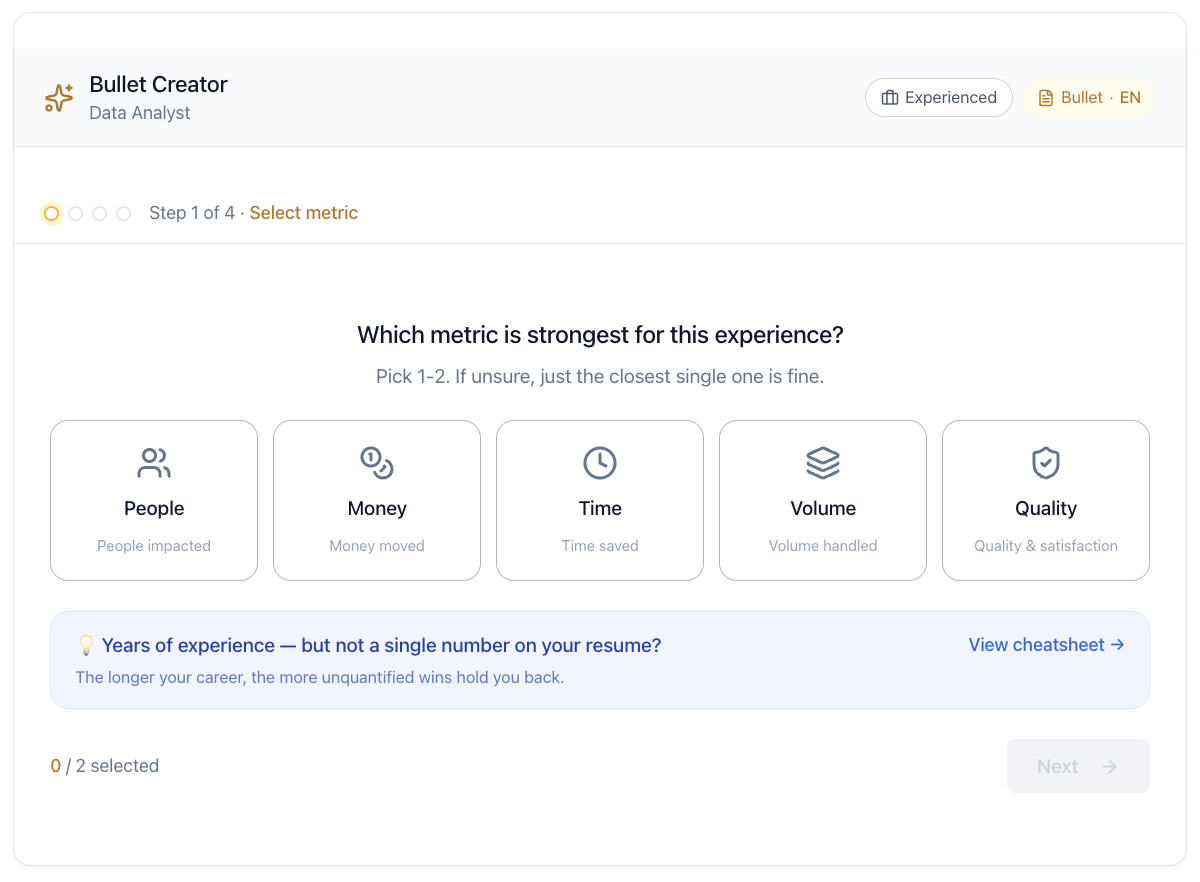
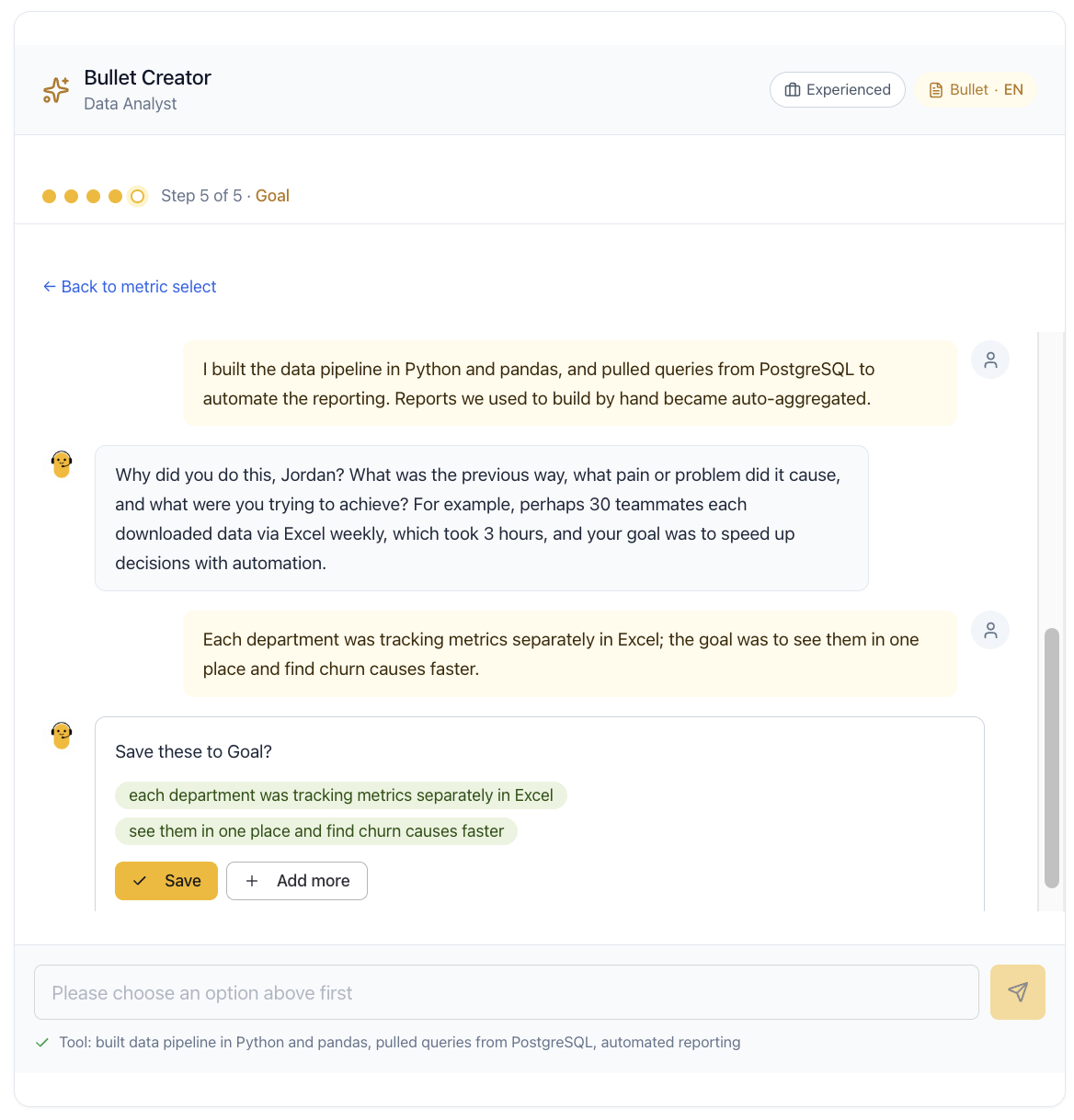
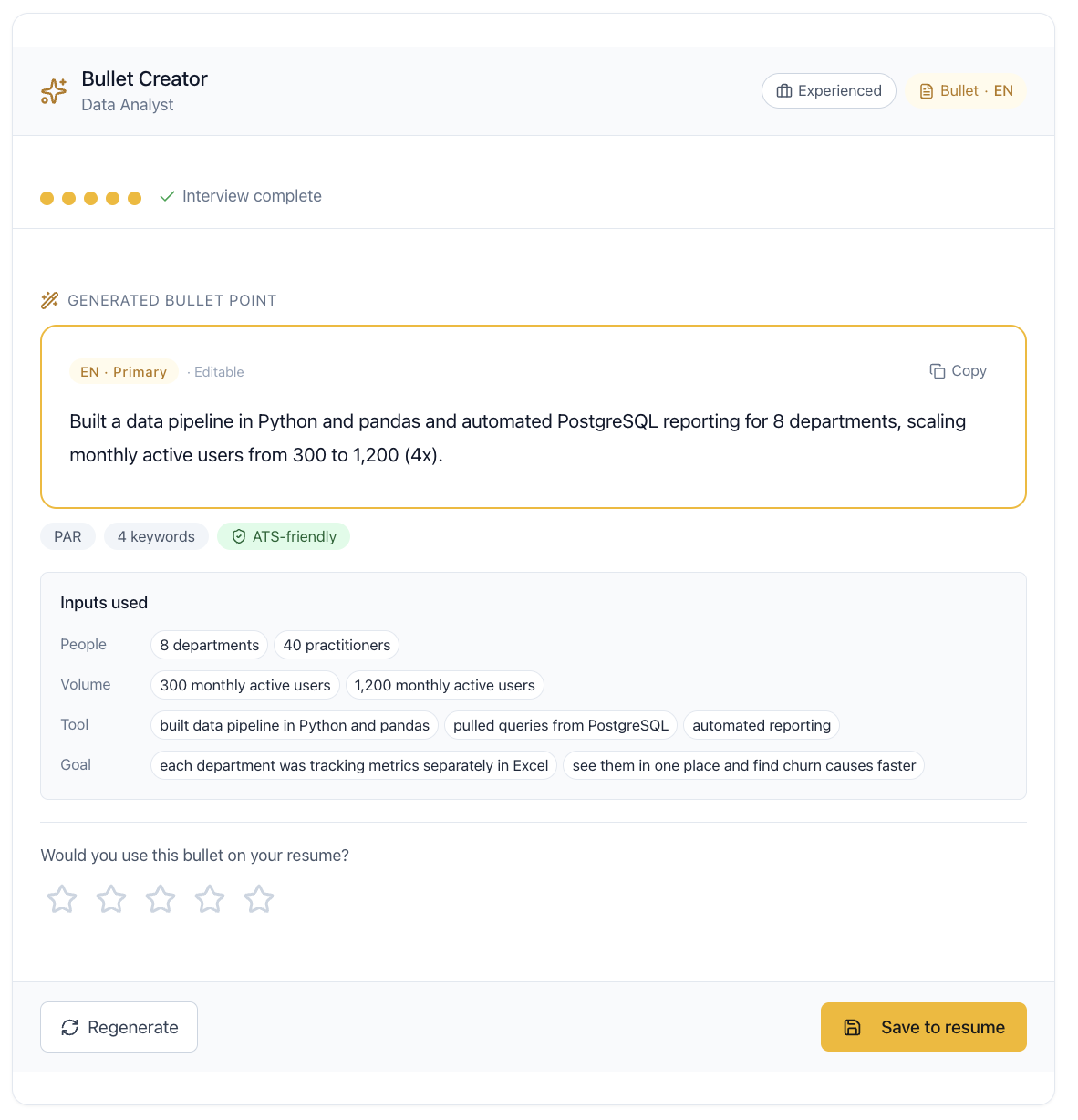
Start with Bullet Creator — three steps to convert one accomplishment into a reusable impact bullet that satisfies Rule #3 (metric density) and Rule #4 (AI outcomes) by construction:
1 · Pick 1-2 PMTVQ axes (People, Money, Time, Volume, Quality).
2 · AI Interview — surfaces the numbers and context you'd otherwise forget while preserving your figures verbatim.
3 · X-Y-Z impact bullet — output follows Google's format (Accomplished [X] as measured by [Y], by doing [Z]).
Once the master library exists, the other three tools handle per-application work — the direct operationalization of Rule #6 (Hyper-Personalization):
- JD Clipper (Chrome extension) — Save any LinkedIn / Indeed / Greenhouse / Lever posting with one click; ATS-optimized keywords extracted automatically by weight (must-have hard skills · domain terms · nice-to-have soft skills).
- Resume Generator — Matches saved postings against your master bullet library and assembles the company-tailored resume as X-Y-Z impact bullets.
- Cover Letter Generator — Drop in the company's homepage URL; scanner reads six categories of company signal and drafts a cover letter as an achievement-led 4-part narrative (result → context → action → value, 15/20/50/15%).
Start with Bullet Creator → — build the library once; the 7 rules hold across every application.
Where this fits
Foundational: What is ATS in 2026 · Entry-Level Resume. Next: Hidden Metrics by Job Role · Bullet Quantification 101 · Cover Letters.
Sources: Ladders 2018 eye-tracking research (7-second recruiter scan), Jobscan 2025 State of the Job Search (ATS adoption rates), Workday and Greenhouse public resume parsing documentation, Bullets Editorial framework for ATS 1.0 → 2.0 transition analysis.
Tagged with
Comments
0 comments
No comments yet. Be the first to comment!
Ready to build your resume?
Bullets — Tailored resumes and cover letters, faster.