Bullet Quantification 101: Turning 'Improved Efficiency' into Real Numbers
Every guide says 'quantify your impact.' Almost none teach how. The X-Y-Z impact bullet (Google's format), a 3-step method for building one, a full Before → After walkthrough on a mid-career profile, five common traps to avoid, and a pre-send checklist. The methodology piece that pairs with Hidden Metrics by Job Role for role-specific depth.
Published
Aug 3, 2026

Every career guide repeats the rule "quantify your impact." Almost none teach the how. The gap between knowing you should quantify and actually rewriting a resume bullet is where most mid-career job searches quietly stall.
The 2026 reality: at least two-thirds of your Experience bullets need real numbers. Any bullet ending in "improved", "responsible for", or "worked on" fails both the ATS 2.0 semantic filter (Rule #3 of the ATS 7 Rules 2026) and the recruiter's 7-second scan. This isn't preference — it's what determines shortlist visibility.
Two bullets on the same work, and what recruiters actually read:
Weak:
"Improved team efficiency through workflow redesign."
Strong:
"Cut ticket-handling time from 42 min to 11 min (-74%) across 6 agents by redesigning Zendesk triage macros."
Three signals in one line: metric + delta + mechanism. The weak version delivers none.
This piece is the methodology: the X-Y-Z impact bullet (Google's canonical format), a 3-step method for building one from any accomplishment, a full transformation walkthrough on a mid-career profile, five common traps that undo the work, and a pre-send checklist before you submit.
For role-specific metric ideas and PMTVQ deep dives, pair this with Hidden Metrics by Job Role.
1. The X-Y-Z Impact Bullet · Google's Format
Google's public recruiting guidance formalizes the shape most modern resume bullets take:
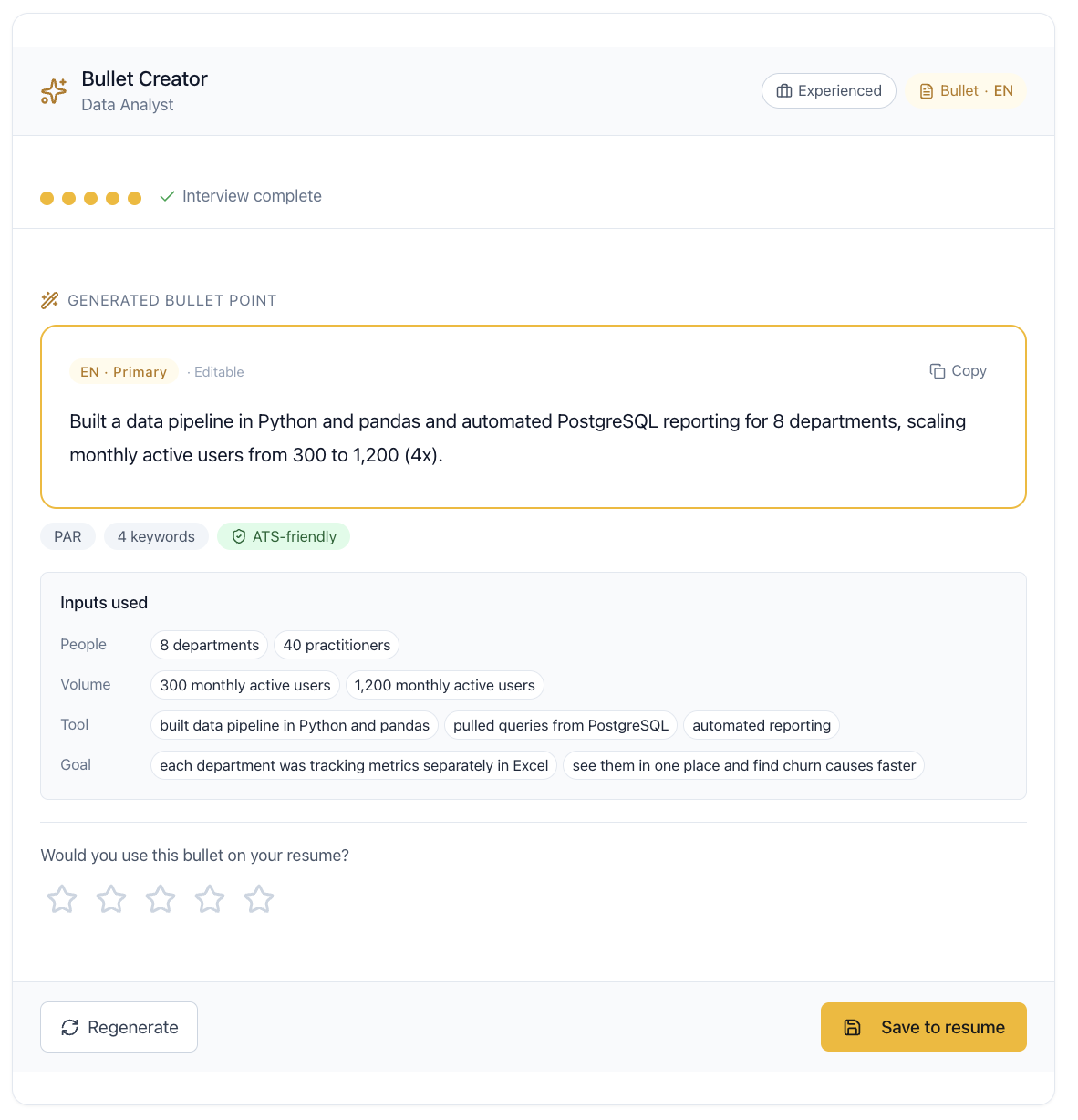
"Accomplished [X] as measured by [Y], by doing [Z]."
Three components:
| Component | What it captures | Example |
|---|---|---|
| X · Result | The outcome you achieved | "Reduced checkout drop-off" |
| Y · Measurement | The number that proves the result | "38% → 24%, worth ~$180K quarterly revenue" |
| Z · Method | How you did it (tools, actions, mechanism) | "By running 6 SQL/Looker A/B tests" |
Combined:
"Reduced checkout drop-off 38% → 24% (worth ~$180K quarterly revenue) by running 6 SQL/Looker A/B tests."
Why X-Y-Z beats other formats on a resume:
- 7-second scan reads left-to-right, top-to-bottom — result-first surfaces the outcome before the reader loses attention
- Multi-sentence STAR framing (Situation-Task-Action-Result) doesn't fit — trying to compress STAR into one line either loses the result or bloats past scan speed
- Single-noun formats ("Marketing analytics") fail — no verb, no delta, no signal
X-Y-Z belongs on the resume. STAR belongs in the behavioral interview. Achievement-led 4-part narrative belongs in the cover letter. Match the format to the reading context.
2. The 3-Step Method · From Vague to X-Y-Z
Y (the measurement) is where most people stall. X and Z usually come easy — "I did the onboarding redesign" — but "by how much" is where the writing gets stuck.
Step 1 · Pick 1-2 PMTVQ axes for the accomplishment
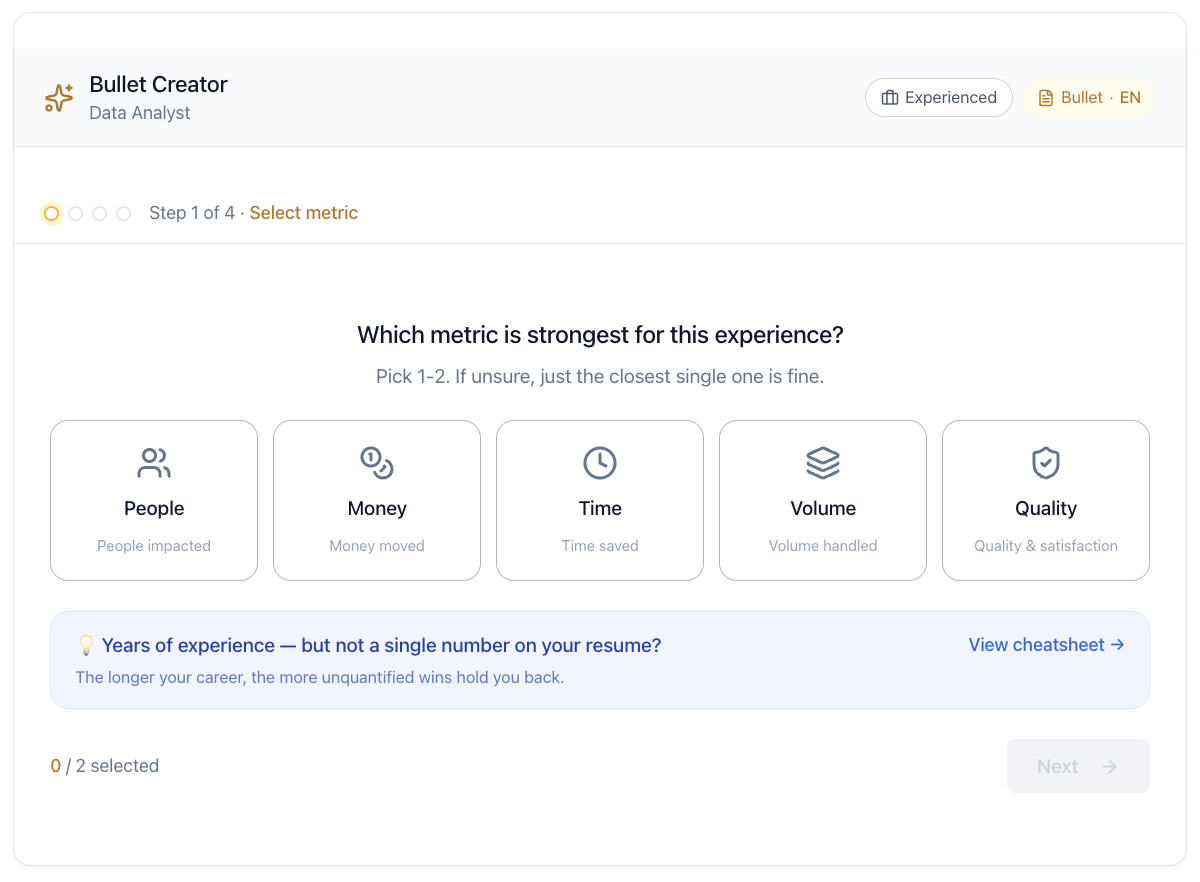
Every accomplishment lands on at least one of five measurement axes:
- People · reach, team size, mentees, stakeholders
- Money · budget owned, cost saved, revenue driven
- Time · cycle time, duration, time-to-value
- Volume · throughput, transactions, counts
- Quality · NPS, defect rate, retention, satisfaction
1 axis = defensible · 2 axes = strong · 3 axes = complete. Walk through all five for any accomplishment; most surface numbers on 2-3. Which axes surface determines how you'll write the bullet.
Deep dive by role: Hidden Metrics by Job Role has typical PMTVQ combinations for HR, Design, PM, Legal, Finance, Ops, CS, and DevOps.
Step 2 · Before → After beats a single point
A single number is often un-evaluable. "NPS 52" — is that good?
"NPS 22 → 41" creates a 19-point delta the reader instantly grades as significant. Before/After pairs are 2-3× stronger than single-point metrics because they show the change you're accountable for, not just the endpoint.
Apply to any axis:
- P: "Trained 12 new hires" → "Grew team from 6 to 18"
- T: "Cycle time 4 days" → "Cycle time 4 days → 1.5 days"
- V: "200 tickets/quarter" → "200 → 380 tickets/quarter with same headcount"
Step 3 · Ratio + Absolute together
Neither ratio alone nor absolute alone tells the full story:
- Ratio only ("-74%") — improvement magnitude clear, scale unknown
- Absolute only ("$320K saved") — scale clear, delta unknown
- Both together ("$320K saved (-42%)") — reader instantly gets both
Combined, the three steps produce a bullet that fits the X-Y-Z shape naturally. Result (X) leads; measurement (Y) shows delta + scale; method (Z) closes with the mechanism.
3. Transformation Walkthrough · Mid-Career Data Analyst
Same 5-year experience, two versions.
Before (responsibility-style · 0 numbers):
- Marketing data analysis and big-data handling
- Company-wide data integration work
- Cross-functional reporting
After (X-Y-Z impact bullets):
- Built marketing analytics pipelines processing ~50M daily events across 8 channels in BigQuery/Python, lifting blended ROAS by 24% on a ~$3M annual paid budget.
- Led company-wide data unification across 17 source systems and 4 departments (~80 users), cutting ad-hoc requests by ~62% (est. 30+ hrs/week freed).
- Delivered cross-functional weekly reporting to product, marketing, and finance leadership — automated 12 recurring reports in Looker, reducing manual reporting time by 8 hrs/week across the team.
Same person, same 5 years. The After version:
- Every bullet leads with a verb (Built, Led, Delivered)
- Every bullet ends with a number (%, $, hours, count)
- Every bullet has a mechanism (BigQuery/Python, Looker, specific system count)
- Numbers include Before/After pairs where possible (ROAS lift, hours freed)
- Money masked as range (~$3M, not exact figure) to respect NDA
The transformation isn't translation — it's re-formatting the same underlying work for a different evaluation algorithm.
4. Five Common Traps
① Title translation without context. "Assistant Manager" means different responsibilities across countries and industries. Add a one-line company or team descriptor if your title alone doesn't convey scope: Senior Marketing Specialist (equivalent to Assistant Manager; team of 4).
② "Successfully / Responsible for" overuse. These phrases add words without adding signal. Replace with the verb that describes what you actually did: Reduced · Grew · Shipped · Built · Led · Migrated · Architected · Owned · Automated. Verb diversity across 20+ bullets also matters — same verb 3+ times reads as template-generated.
③ Missing company-scale context. Recruiters may not recognize your employer. Adding one line next to the company name changes the perceived weight of every bullet in that block: Confidential — Series C B2B SaaS (~$40M ARR, 250 employees) or Tata Consultancy Services (TCS) — India's largest IT services firm, 600,000+ employees.
④ Unit and currency mixing. Don't mix $ and € and £ across bullets. Pick one currency (typically the market you're applying into) and stick with it. Same for MAU vs DAU — pick the one your industry actually uses.
⑤ NDA exposure. Naming a specific customer, exact revenue figure, or unreleased product violates most confidentiality clauses. Mask with ranges, ratios, and abstractions: "a mid-8-figure ARR B2B SaaS product line" rather than "the $47M Acme product line." Recruiters understand ranges; they penalize NDA violations more than they penalize vague specificity.
5. Pre-Send Checklist
Before submitting any resume, verify:
- ✅ ≥ 70% of bullets carry real numbers (or labeled
~estimates) - ✅ Every bullet leads with a verb — no "Responsible for..." openings
- ✅ No verb repeats 3+ times across the whole resume
- ✅ Company name + one descriptor line where the company isn't globally recognized
- ✅ Currency and units consistent across all bullets
- ✅ All figures defensible — you can explain how each was calculated in an interview
- ✅ NDA-safe — no unreleased products, exact confidential revenue, or named customers
Pass all seven and your bullets satisfy both the ATS 2.0 semantic filter and the recruiter's 7-second scan.
6. Automating the Repetitive Work · Bullet Creator
The 3-step method above works, but running it manually per bullet takes 5-10 minutes each. Multiply by 25 bullets on a mid-career resume, and that's 2-4 hours of writing, editing, and second-guessing your own numbers.
Bullet Creator absorbs the 3-step method into a 15-minute AI interview per accomplishment. Your numbers are preserved verbatim — the tool never fabricates figures.
1 · Pick 1-2 PMTVQ axes (People, Money, Time, Volume, Quality) that best fit the accomplishment.
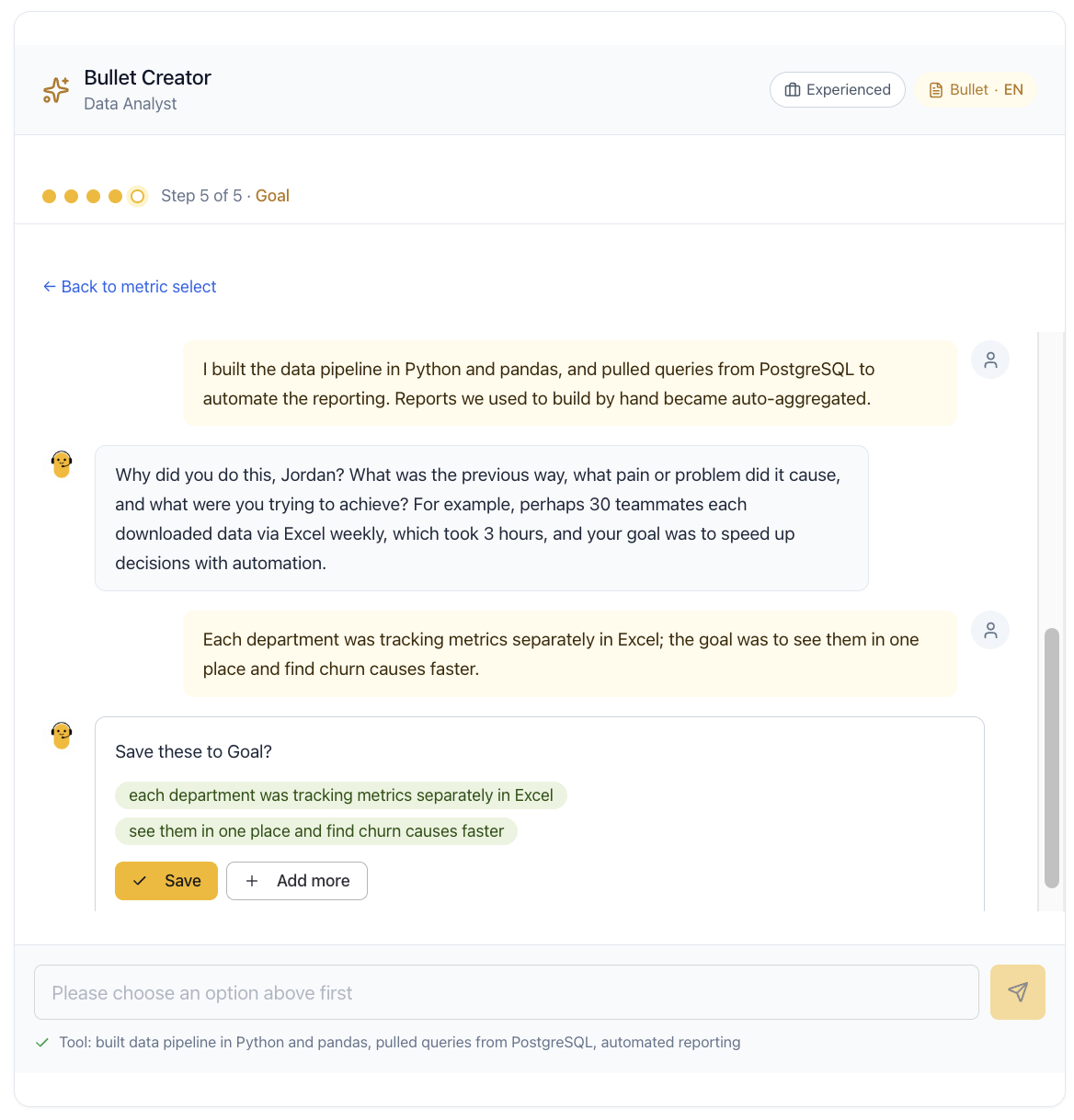
2 · AI Interview — conversational questions surface the specific numbers, tools, and context. Your figures come out exactly as you input them.
3 · X-Y-Z impact bullet — output follows Google's format, ready for the resume.
The compounding value: once an accomplishment is captured in canonical form, it feeds not just your resume, but also cover letter Proof paragraphs and behavioral interview STAR stories — all drawing from the same source of truth. See Senior IC Triple-Artifact Workflow for the multi-surface pattern.
The other three Bullets tools handle per-application work:
- JD Clipper (Chrome extension) — Save any LinkedIn / Indeed / Greenhouse / Lever posting; ATS-optimized keywords extracted automatically by weight.
- Resume Generator — Matches saved postings against your master bullet library and assembles the company-tailored resume as X-Y-Z impact bullets.
- Cover Letter Generator — Drops in the company's homepage URL; drafts a cover letter as an achievement-led 4-part narrative (result → context → action → value, 15/20/50/15%).
Start with Bullet Creator → — turn one responsibility bullet into a defensible X-Y-Z in ~15 minutes. Numbers verbatim, PMTVQ hints for what you might've missed.
Where this fits
Foundational: What is ATS in 2026 · ATS 7 Rules 2026. Related: Hidden Metrics by Job Role — the role-specific depth companion to this piece · Entry-Level Resume · Senior IC Triple-Artifact Workflow.
Sources: Google's public recruiting guidance on the X-Y-Z bullet format · Ladders 2018 eye-tracking research (7-second recruiter scan) · Bullets Editorial framework for the 3-step method and defensible-estimate rules.
Tagged with
Comments
0 comments
No comments yet. Be the first to comment!
Ready to build your resume?
Bullets — Tailored resumes and cover letters, faster.