Entry-Level Resume With No Experience: Quantify Projects, Clubs, and Internships
"I have no experience to put on my resume." You have four years of team projects, clubs, competitions, and internships — they're just not quantified yet. Five common sources most entry-level applicants overlook, PMTVQ applied to student life, three detailed Before → After walkthroughs, and target-role matching for when you're still deciding which direction to apply.
Published
Jun 15, 2026

You open your resume template with 40 applications on this week's list. Your career section is blank, your GPA is a mixed bag, that internship never happened, and the club activities feel too generic to matter. "I have no experience to put on this resume" is the sentence that follows — usually paired with a 3 AM decision to just list your degree, your relevant coursework, and hope for the best.
That resume gets 7.4 seconds of a recruiter's attention (Ladders 2018 eye-tracking research). Adjectives read as noise; numbers read as signal. And here's the reframe recruiters are practically shouting into the void: entry-level applicants don't need enterprise-scale metrics. You need the numbers that are already inside the four years of activities you've already done — team projects, clubs, competitions, internships. They just haven't been quantified yet.
This piece is that quantification guide: five common sources most students overlook, the PMTVQ 5-axis framework applied to student life, and three detailed walkthroughs showing the Before → After transformation. By the end, you should be able to convert one activity into a resume-ready bullet in under 30 minutes.
1. Five Sources of Numbers Most Entry-Level Applicants Miss
Almost every activity from the past 3-4 years lives in one of five buckets. Each has hidden metrics students consistently under-mine:
| Source | Common Examples | Hidden Numbers | Priority Tip |
|---|---|---|---|
| ① Class projects | Case studies, capstones, group papers | Team size, data volume, grade percentile | 4+ person team + quantified outcome = strong |
| ② Clubs & student organizations | Marketing chapters, student government, professional societies | Membership size, budget, social media following | Officer/board roles are ~3× stronger than general member |
| ③ Ambassador / campus roles | Brand ambassadors, campus reps, tour guides, tutors | Reach, content produced, engagement | 6+ months of continuous work stands out |
| ④ Competitions & hackathons | HackMIT, case competitions, business plan contests | Placement, team count, prize amount | "Top X% of Y teams" is stronger than raw placement |
| ⑤ Internships / part-time / volunteer | Summer interns, work-study, tutoring | Transactions handled, CSAT, students taught | Directly related to target role = highest priority |
Every source hits at least 2 of the 5 PMTVQ axes. The lesson recruiters repeat: a quantified common activity beats an unquantified special one, every time.
2. PMTVQ for Students
The five measurement axes, with the ones most productive for entry-level applicants highlighted:
- People — teammates, audience size, social followers, mentees. The strongest axis for students — nearly every activity has a People number.
- Money — club budget managed, prize or scholarship won, sponsorship raised, project budget owned
- Time — project duration, time saved by an automation you built, months of continuous activity
- Volume — content pieces published, interviews conducted, events run, transactions processed. The easiest to surface — count what you actually did.
- Quality — GPA, engagement rate, top X% placement, customer satisfaction, retention
Run any activity through these five. Most student activities yield numbers on 2-3 axes. Which axes surface determines the angle you'll use when writing the bullet.
3. Three Walkthroughs · Before → After
① Marketing club — chapter officer
Before: "Served on marketing club leadership and helped plan events."
After:
"Content Lead among 6 officers of a 40-member marketing chapter. Ran 8 seminars + 2 external speakers + 1 conference over 2 semesters. Grew Instagram from 1,200 to 3,400 followers (+183%), average reach 8,000+. Managed $4,800 operating budget."
PMTVQ breakdown: People 40 members · 6 officers · 3,400 followers / Money $4,800 / Time 2 semesters / Volume 8 seminars / Quality +183%
② Capstone project — data lead
Before: "Completed a capstone project analyzing e-commerce data with teammates."
After:
"Data lead on a 4-person capstone. Cleaned 120K rows of public US e-commerce data with SQL and Python pandas; built a repurchase prediction model (78% accuracy) over 6 weeks. Top 3 of 18 teams in department presentation."
PMTVQ breakdown: People 4 team · 18 teams / Time 6 weeks / Volume 120K rows / Quality 78% accuracy · Top 3
③ National startup competition — founding member
Before: "Participated in a startup competition and submitted a service concept."
After:
"Founding member of a 3-person team at a national collegiate startup competition. Submitted B2C subscription concept — customer survey (320 responses), competitor analysis (5 companies), Figma prototype (24 screens). Advanced to finals: 32 of 240 teams (top 13%), awarded Grand Prize ($2,500)."
PMTVQ breakdown: People 3 team · 320 respondents / Money $2,500 / Volume 24 screens · 5 competitors / Quality top 13% · Grand Prize
The same pattern works for ambassador programs, internships, and part-time work. Ambassador/rep roles are typically strongest on Volume + Quality (posts produced + engagement rate). Internships and part-time work are typically strongest on Volume + Money (transactions processed + revenue contribution).
4. "No Experience" Was Actually "Not Quantified Yet"
All three Before examples above start with vague verbs — served, completed, participated. Each looks unremarkable on the page. Run through PMTVQ, each surfaces numbers on 3-5 axes — enough to build a resume bullet that survives both the ATS filter and the recruiter's 7-second scan.
Rough time budget:
- First activity (PMTVQ breakdown → bullet draft) = 30-45 minutes
- From the second onward = ~15 minutes each (the pattern clicks fast)
- Four hours of a Sunday afternoon = all four years of student activities quantified
What's left in your hands is a master library of quantified accomplishments that assembles into a role-specific resume in minutes, rather than starting from scratch every application. The library carries with you far beyond the entry-level job hunt.
5. Verbs That Land in a 7-Second Scan
Once the numbers are in place, verbs carry the weight. For entry-level scans:
Safe · high-signal: Built, Delivered, Launched, Grew, Reduced, Led, Owned, Analyzed, Designed, Presented
Avoid at entry-level:
- Spearheaded / Orchestrated / Championed — reads as ChatGPT output or title inflation on a 3-person project
- Responsible for / Assisted with — filler that adds nothing (either you did it or you didn't; if you did, use the verb)
Every bullet leads with a verb. Every verb points to a number.
6. Portfolio Links Are Supplementary — Not a Substitute
Common pattern: student uploads a beautiful portfolio to GitHub Pages / Notion / Behance, adds the URL to their resume, and lets the portfolio "carry" the qualitative depth. Problem: portfolio links are rarely crawled by the ATS. The parser sees the URL string, not the content behind it. If the achievements aren't quantified in the resume itself, the resume won't come back in a recruiter's keyword search — regardless of how strong the portfolio is.
Rule: the resume must stand alone against the ATS. Portfolio links add depth for the humans who actually visit them; they don't rescue an under-quantified resume from filter invisibility.
7. If Your Target Role Isn't Set Yet
Common blocker for entry-level applicants: unsure which target role to frame activities toward. You have four years of work but multiple possible directions — Product Analyst? Marketing Ops? Backend Engineer? Data Scientist?
Bullet Creator's target-role matching surfaces the answer from your existing activities:
- Role fit % — how much your current master library covers a specific role's typical requirements (e.g., Data Analyst: 43%)
- Recommended keywords — the specific skills or experiences to add to raise that % (e.g., SQL, Tableau, Power BI, Data Visualization, Statistical Analysis)
- Closer alternative roles — roles your existing work maps to more directly than your stated target (e.g., "Backend project experience clusters closer to Cloud Engineer or Python Developer than to Data Analyst")
For entry-level applicants without a strong pre-existing preference, this creates a useful loop: quantify → check fit % → adjust target list → apply to both original and closer-fit roles → measure interview response rate. The market's actual response tells you which direction was strongest. That's a signal only available while your target is still fluid — a window that mostly closes after your first full-time role.
8. Automating the Repetitive Work
The four Bullets tools convert the four-year quantification project into a repeatable per-application workflow.
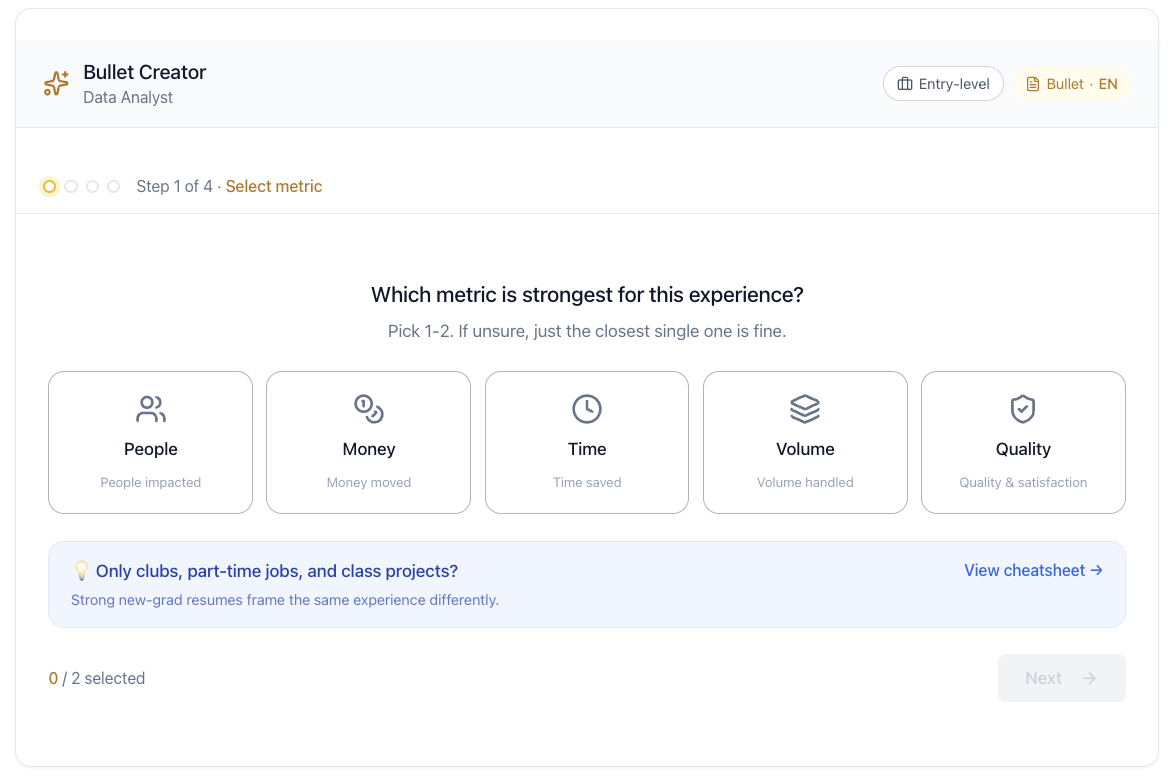
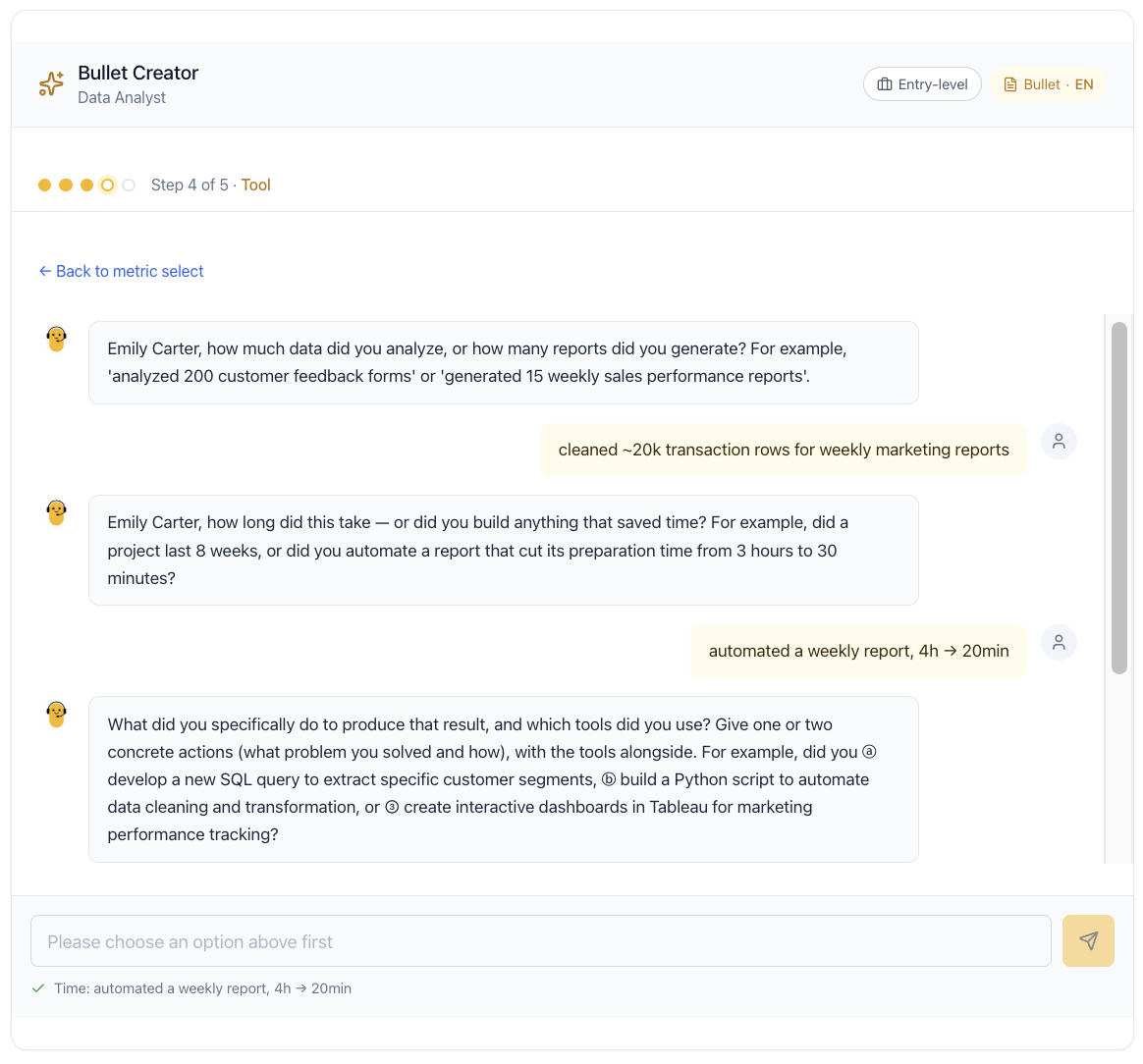
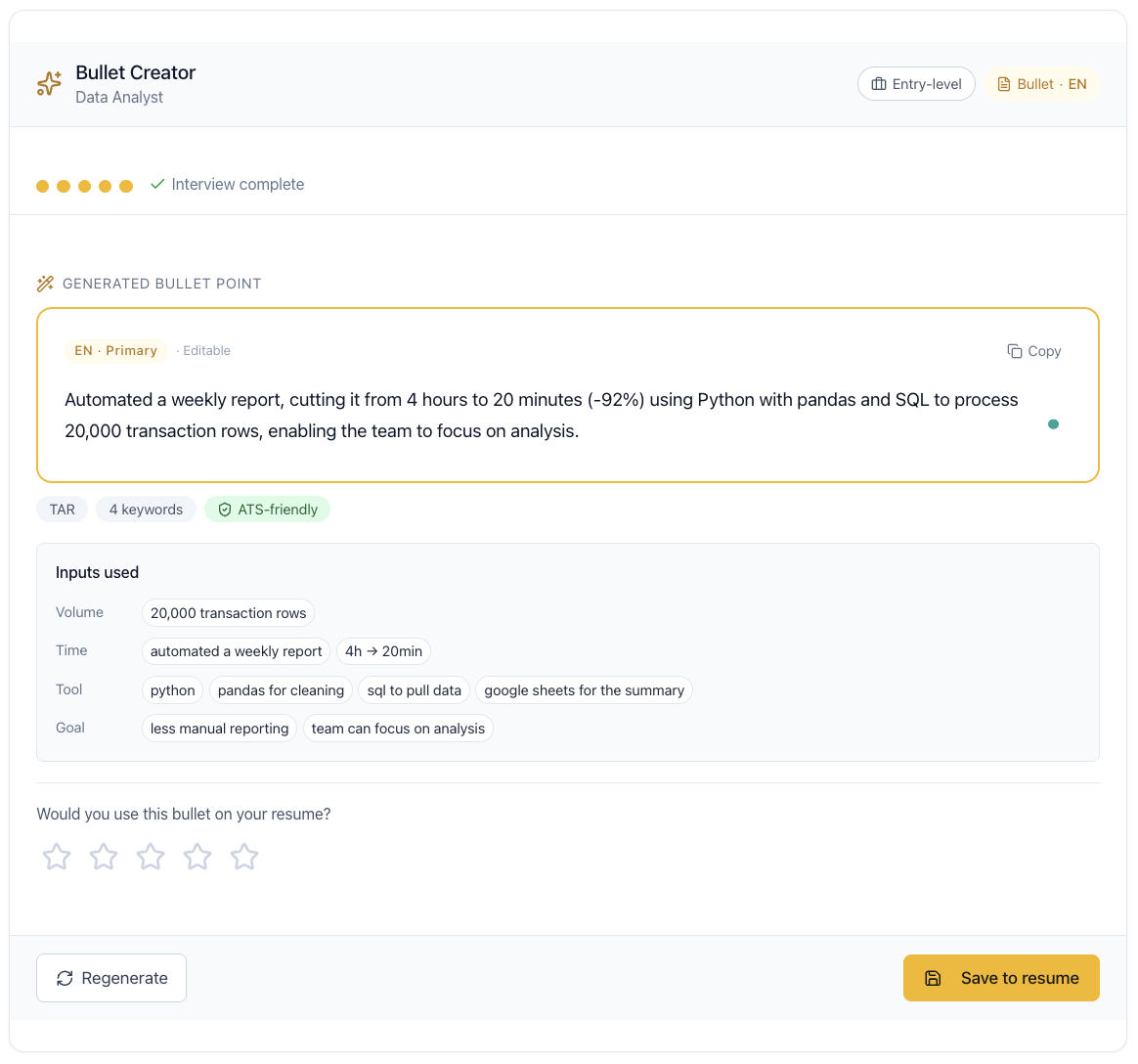
Start with Bullet Creator — three steps to convert one accomplishment into a reusable impact bullet:
1 · Pick 1-2 PMTVQ axes. People and Volume are easiest for student work.
2 · AI Interview. Focused questions surface team size, tools, and baselines while preserving your real numbers verbatim.
3 · X-Y-Z impact bullet. Native English output following Google's format (Accomplished [X] as measured by [Y], by doing [Z]).
Once the master library exists, the other three tools handle per-application work:
- JD Clipper (Chrome extension) — Save any LinkedIn / Indeed / Greenhouse / Lever posting with one click; ATS-optimized keywords extracted automatically by weight (must-have hard skills · domain terms · nice-to-have soft skills).
- Resume Generator — Matches saved postings against your master bullet library and assembles the company-tailored resume as X-Y-Z impact bullets.
- Cover Letter Generator — Drop in the company's homepage URL; scanner reads six categories of company signal and drafts a cover letter as an achievement-led 4-part narrative (result → context → action → value, 15/20/50/15%).
Start with Bullet Creator → — quantify your first activity in 15 minutes.
Where this fits
Foundational: What is ATS in 2026 · ATS 7 Rules 2026. Next: Gap Analysis · Bullet Quantification 101 · Hidden Metrics by Job Role.
Sources: Ladders 2018 eye-tracking research (7.4-second recruiter scan), Bullet Creator PMTVQ framework applied to student contexts.
Tagged with
Comments
0 comments
No comments yet. Be the first to comment!
Ready to build your resume?
Bullets — Tailored resumes and cover letters, faster.