Senior IC Triple-Artifact Workflow: One Achievement → Resume Bullet + Interview Story + Cover Letter
Senior IC job searches rewrite the same achievement three times per company — resume, cover letter, interview. Numbers drift, framing drifts, credibility drifts. Fix: capture each achievement once as a PMTVQ-quantified bullet, then let JD-matched retrieval fill your resume's bullet count, cover letter paragraphs, and interview STAR shortlist — all from one library. Full workflow with two walkthroughs (SWE → Staff, PMM → Group PMM), library-sizing rules per seniority, and the five common mistakes senior ICs make.
Published
Jul 13, 2026

At Senior / Staff+ IC level, a single job search averages 15-30 applications, and each application asks you to describe your same 8-15 career achievements three separate times:
- Resume — a ~30-word X-Y-Z impact bullet
- Cover letter — a 150-200 word achievement-led narrative
- Interview (recruiter screen · hiring manager · panel) — a ~2-minute STAR story
Do this 20 times over 12 weeks and the same "led the reconciliation migration" story ends up phrased differently across your resume, your cover letters for four companies, and three different interview retells. Numbers drift. Team sizes drift. What "cutover" actually meant drifts. Interviewers notice, and the credibility of every accomplishment quietly erodes.
The fix isn't better writing at each surface — it's writing the accomplishment once, in one canonical form, then deriving all three surfaces from that source of truth. This piece is the workflow: what the three surfaces demand, how PMTVQ becomes the common currency, two walkthroughs that show the transformation end-to-end, and the library sizing that makes it sustainable.
1. The Three Surfaces · What Each Actually Wants
| Surface | Format | Length | Why the format |
|---|---|---|---|
| Resume | X-Y-Z impact bullet (Google's format · Accomplished [X] as measured by [Y], by doing [Z]) | ~30 words · single line | Recruiter's 7-second scan lands on the top of each role — impact-first surfaces at scan speed |
| Cover letter | Achievement-led 4-part narrative (result → context → action → value, 15/20/50/15%) | 150-200 words · one paragraph | Hiring manager's 3-minute read wants the outcome first, then the how (which is your differentiator vs 30 other applicants) |
| Interview | STAR (Situation → Task → Action → Result) | ~2 minutes spoken | Behavioral interview wants sequential detail; the interviewer can interrupt to probe |
The formats differ because the reading contexts differ — 7 seconds vs 3 minutes vs 2 minutes with interruption. What doesn't change: the underlying achievement (the what happened, the scale, the numbers). That underlying achievement is what you should capture once and reuse.
⚠️ STAR belongs in interviews, not resume bullets. Resume bullets that read as compressed STAR ("Situation: our team was falling behind on...") waste the 7-second scan on setup. Keep STAR on the interview surface only. Similarly, X-Y-Z compression on the interview surface (talking in resume-bullet cadence) sounds like a recited script and reads as rehearsed. Match the format to the reading context.
2. PMTVQ · The Common Currency Across All Three Surfaces
The one thing all three surfaces demand: quantified impact you can defend. Not enterprise-level metrics you may not have, but at least two of the five PMTVQ axes:
- People — team size led, stakeholders coordinated, users impacted
- Money — revenue, cost, budget, ARR
- Time — duration, latency, cycle time, time-to-value
- Volume — records processed, throughput, transactions
- Quality — retention, NPS, error rate, defect rate
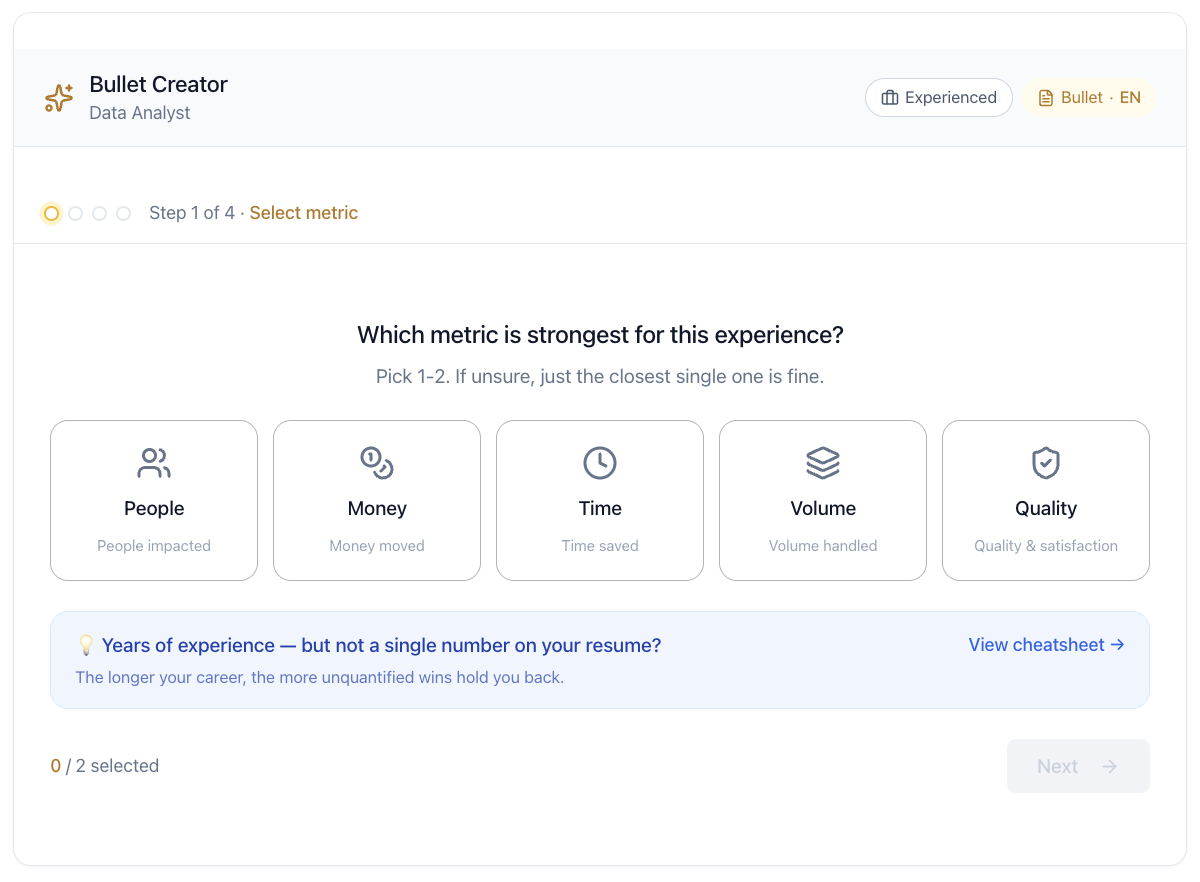
Capture an achievement once with all its available PMTVQ axes. The resume bullet will use the strongest one or two. The cover letter narrative will use three or four (it has more space for context). The STAR interview retell will surface all five if the story runs long. One capture → three levels of extraction.
Deep dive by role: Hidden Metrics by Job Role · Bullet Quantification 101.
3. Walkthrough A · Senior SWE → Staff (Backend Migration)
One-time capture (in Bullet Creator):
- Achievement: 14-month migration of nightly batch reconciliation to event-driven streaming
- P: Led 3 teams (8 engineers total) + mentored 2 juniors to promotion
- M: Cut infrastructure spend ~30% YoY (~$180K annualized)
- T: End-to-end latency 6.5 hours → sub-minute
- V: ~10M+ records/day processed
- Q: Eliminated 12 quarterly manual replays → 0
Resume · X-Y-Z impact bullet (~30 words)
"Architected event-driven migration of nightly reconciliation (~10M+ records/day), cutting latency from 6.5h to sub-minute, eliminating 12 quarterly replays, and reducing infra spend ~30% YoY."
The strongest quantified outcomes lead. Team-size / mentorship / duration surface in cover letter and interview; the resume bullet stays impact-first.
Cover letter · achievement-led 4-part (~180 words)
"The pain that drove this: our nightly batch reconciliation ran 6.5 hours, blocking morning reporting for finance and forcing 12 emergency replays per quarter when it failed. [Result] Migrating to event-driven streaming cut end-to-end latency from 6.5 hours to sub-minute and eliminated replay outages entirely. [Context] The system processed ~10M+ records/day across three product teams; changing it required coordinating 8 engineers and getting downstream finance and BI sign-off. [Action] I designed a dual-run drift-alert harness so the two systems ran in parallel for four weeks; two junior engineers on my team owned the alerting layer end-to-end (both were promoted mid-migration). Sign-off from finance came after the harness caught zero drift for two consecutive weeks. [Value] For a company scaling into more real-time customer-facing use cases, the shift from batch to streaming isn't just a latency win — it's the reconciliation architecture that unlocks the next set of product features. That's the pattern I'd bring."
Interview · STAR (~2 min spoken)
Same underlying beats, expanded conversationally: Situation (batch reconciliation pain, 6.5h, 12 replays/qtr) → Task (migrate to streaming without dropping finance sign-off) → Action (dual-run harness, mentorship of 2 juniors, four-week parallel period) → Result (sub-minute latency, zero replays, ~30% infra saved, two promotions). The interviewer will probe on specifics — you can drill into the harness design, the failure mode that caught a specific bug, or the mentorship approach.
4. Walkthrough B · Senior PMM → Group PMM (GTM Reset)
One-time capture:
- Achievement: 18-month GTM reset for a $8M ARR B2B SaaS product line
- P: Cross-functional coordination across 14 people (4 product · 3 sales · 2 CS · 2 design · 3 marketing)
- M: Retained ~$2M ARR by cutting churn 34% → 19%
- T: 18-month cycle · 2 major repositioning waves
- V: 12 customer interviews · sunset 2 underperforming features
- Q: NPS 22 → 41
Resume · X-Y-Z impact bullet (~30 words)
"Reset GTM on an $8M ARR B2B SaaS line with a 14-person cross-functional team — cut churn 34%→19% (~$2M retained) and lifted NPS 22→41 by sunsetting 2 features and repositioning around 12 customer interviews."
Cover letter · achievement-led 4-part (~180 words)
"[Result] Over 18 months I led the GTM reset of our $8M ARR B2B SaaS product line, cutting churn from 34% to 19% (~$2M retained) and lifting NPS from 22 to 41. [Context] The line had drifted — engineering was shipping into every enterprise sales ask, and the product had accumulated 40+ features nobody's users actually adopted. Cross-functional alignment across 14 people (4 product · 3 sales · 2 CS · 2 design · 3 marketing) was the hardest part. [Action] The reset was two waves: a first wave that ran 12 in-depth customer interviews to identify what enterprise buyers actually valued (only 8 of 40+ features), and a second wave that sunset 2 features that were absorbing 30% of engineering capacity for 4% of retention. Repositioning followed the interviews — new pricing tiers, new sales enablement, new website copy. [Value] For a company scaling into multi-product where each line risks the same drift, the framework of "customer interviews first, feature roadmap second" is what I'd bring."
Interview · STAR (~2 min spoken)
Same beats. Interviewer probes: which customer interviews, what specifically the 2 sunset features were, how you handled sales' resistance to the pricing change, what the NPS baseline was measured against.
5. Library Sizing · How Much to Capture
Not every achievement in your career goes into your library. There's an optimal density per seniority:
| Level | Library Size | Slot Size (Resume) |
|---|---|---|
| Mid IC (5-7 YOE) | 15-25 canonical achievements | 12-18 bullets on a 1-page resume · 20-30 on 2-page |
| Senior IC (7-10 YOE) | 25-40 canonical achievements | 20-30 bullets on 2-page resume |
| Staff+ / Principal / Distinguished (10+ YOE) | 10-20 canonical achievements | 4-7 bullets per role block · fewer roles, deeper |
The Staff+ counter-intuition: your library gets smaller, not larger. At the Staff level, hiring managers want to see 3-5 achievements of truly transformative scope — not 30 achievements of tactical execution. Prune ruthlessly. If an achievement doesn't tell a "changed the trajectory of X" story at Staff+ level, it goes into a "prior work" one-liner rather than a full bullet.
Per-application slot allocation: for each block (role) on your resume, 4-7 bullets. Multiply by number of roles = your total resume slot count. Your library should have ~1.5-2× that number so JD-matching has real choice. If your library equals your resume slots exactly, you're not selecting per JD — you're using everything for every application.
6. The JD-Matched Retrieval Loop
The workflow that makes triple-artifact reuse actually sustainable:
Capture (in Bullet Creator, one-time per achievement) → Configure Bullet Count per role block per company → Retrieve top N matching the JD's keyword weights → Derive cover letter + STAR from the same retrieval selection → Update if you add a new achievement or a JD surfaces a keyword you're missing.
▲ Resume Generator ranks your library against a saved JD and assembles the top-matching bullets into the per-role slot count you configured.
The compounding value: the same 5-8 bullets that Resume Generator selects for a specific JD are also the top-5-8 for that JD's cover letter and interview prep. One retrieval → three surfaces. Doing 20 applications no longer means rewriting the same 8 achievements 60 times.
Chrome extension JD Clipper: paste any Staff / Principal / Distinguished-level JD into the side panel. AI extracts weighted keywords, scope signals (team size expected, ARR ranges, tech stack depth), and level cues (Staff vs Principal vs Distinguished expectations). These feed the retrieval automatically.
7. Five Common Mistakes at Senior IC Level
① Compressing STAR into resume bullets. The bullet reads like "Situation: as our infra scaled to 10M records/day..." — the 7-second scan lands on setup, not impact. Lead with the result; keep STAR for the interview surface only.
② Never pruning the library. Adding new bullets without retiring old ones inflates the library beyond usable size. At Staff+, you should be removing more than adding as your seniority increases — early-career tactical wins don't earn slots against Staff-level transformative work.
③ NDA over-caution. Naming the customer or the exact revenue figure violates NDA; describing the pattern and the scope range does not. Bullets like "cut churn from 34%→19% on a mid-8-figure ARR B2B SaaS product line" respect NDA while giving recruiters and interviewers the scale signal they need. Bullets that read "drove significant improvement across a large enterprise product" are NDA-safe but scope-blind — those get skipped.
④ Different numbers across resume, cover letter, and interview. You wrote "$180K infra saved" on the resume, "about $200K" in the cover letter, and "roughly $150K" in the interview. Not intentionally — it's what happens when you draft each independently from memory. Interviewers who cross-reference notice, and it reads as embellishment even when it's just drift. Single-source retrieval solves this by construction.
⑤ Not re-running the loop when a JD surfaces a new keyword. A Staff Data Platform Engineer posting mentions "data mesh" as a must-have. You have relevant work, but no bullet uses that phrase. Rather than force it into an existing bullet, capture a new bullet with the phrasing intact — future JDs at other Staff Data Platform roles will use the same keyword.
Automating the Repetitive Work
The four Bullets tools operationalize the triple-artifact workflow:
- Bullet Creator — AI interview captures each achievement in canonical form with all PMTVQ axes preserved verbatim. This is your single source of truth across all three surfaces.
- JD Clipper (Chrome extension) — Save any Senior / Staff / Principal JD with one click; extracts ATS-optimized keywords, scope signals, and level expectations by weight.
- Resume Generator — Configures bullet count per role block per company; retrieves top-N matching bullets against a saved JD; assembles as X-Y-Z impact bullets.
- Cover Letter Generator — Drops in the company's homepage URL; scanner reads six categories of company signal and drafts a cover letter as an achievement-led 4-part narrative (result → context → action → value, 15/20/50/15%) — drawing from the same selection as the resume.
Interview STAR prep uses the same top-N retrieval — you're rehearsing the exact achievements a hiring manager will see on your resume, not a separately-recalled set.
Start with Bullet Creator → — one achievement takes ~20 minutes to capture; once captured, it feeds all three surfaces for every future application.
Where this fits
Foundational: What is ATS in 2026 · ATS 7 Rules 2026. Related: LinkedIn for Mid-Career · Hidden Metrics by Job Role · Cover Letters 3-Paragraph Playbook.
Reflects Senior / Staff+ IC search patterns across US / UK / CA / AU / EU markets, 2026. STAR interview practice per behavioral-interview standards used at major tech companies.
Tagged with
Comments
0 comments
No comments yet. Be the first to comment!
Ready to build your resume?
Bullets — Tailored resumes and cover letters, faster.