Gap Analysis for Your Target Role: How to See What You're Missing
Applying to jobs blindly wastes months. Gap analysis parses 5 target JDs, inventories your current profile, and surfaces the specific hard skills, experiences, and credentials you actually need to build. A three-step framework entry-level candidates can run on themselves in one afternoon — plus severity rules for what to fix now vs park, bridge strategies for large gaps, and five common mistakes that make the analysis worse than nothing.
Published
Jul 6, 2026

"Applying to PM roles but never shipped one. Every rejection feels random."
It's not random. Three filters decide every entry-level outcome, and all three point to the same signal:
- Knock-out questions on the application form — degree, visa (H-1B / OPT / TN in US; Skilled Worker in UK; LMIA/GTS in Canada; Subclass 482 in Australia), YOE minimum, location. Fail one and no one reads the file.
- The recruiter's 7-second scan — is the seniority right? Do the last 3 bullets show relevant impact? Are the tools they filter on visible?
- Boolean search inside the ATS — every must-have keyword you don't have, in real context, in a real bullet drops you out of the shortlist.
All three are saying the same thing: "Your profile is missing X for this role." Gap analysis is the exercise of finding X before applying, not after 60 rejections.
Baseline reading: Entry-Level Resume for how to quantify what you already have.
1. The 3-Step Framework · One Afternoon
① Specify the target on one line
"PM" is a category, not a target. "Data role" is a category, not a target. A specifiable target has five components:
- Function: PM, Data Analyst, Backend Engineer, Growth Marketer, etc.
- Seniority: entry-level rung (APM · Analyst · Associate · Junior)
- Company stage: Series A · Series B · public tech · consulting · Big Tech · government
- Industry: B2B SaaS · fintech · healthcare · marketplace · consumer
- Work style: on-site / hybrid / remote · location bounds
Weak target: "PM at a good company."
Specifiable target: "APM at Series B B2B SaaS in US or Remote, prefer product-led-growth motion."
The specifiability isn't gatekeeping — it's the only way Steps 2 and 3 can produce actionable answers. If you can't specify, spend a day narrowing before proceeding.
② Extract the ideal profile from 5 JDs
Grab 5 real job postings that match your target (LinkedIn / Indeed / Greenhouse / Lever / Wellfound). Fewer than 5 is noise; more than 8 diminishes returns.
Per JD, tag every requirement into four buckets:
- Hard skills / tools (SQL, Figma, Amplitude, dbt, K8s)
- Experience patterns ("shipped to real users," "cross-functional with engineering," "owned a metric end-to-end")
- Credentials (degree, cert, portfolio, publications)
- Nice-to-haves (explicitly labeled "preferred" or "bonus")
Cross-reference across 5 postings:
- Appears in 4-5 of 5 → must-have (real gap to close)
- Appears in 3 of 5 → strong preference (worth building)
- Appears in 1-2 of 5 → noise (skip for now)
JD Clipper automates this parsing — paste any JD into the extension side panel and the tool extracts weighted requirements. Doing five JDs takes ~10 minutes total.
③ Inventory yours vs the ideal
Take each must-have from Step 2 and mark against your existing profile / bullet library:
- ✅ Have — Skill is present, quantified in at least one bullet, defensible in interview
- 🟡 Adjacent — Related skill exists, needs rewording or a bridge bullet
- ❌ Missing — No experience yet; requires building
The 🟡 items are your fastest wins — often just a bullet rewrite. The ❌ items are where the real career-build effort goes.
If you already have a master bullet library in Bullet Creator, the target-role matching feature does this inventory automatically — surfacing a role-fit percentage, the specific keywords you're missing, and closer alternative roles that your existing work already qualifies for. That last one is often the surprise.
2. Gap Types · Severity Matrix
Not all gaps take the same time or effort to close. Sort them:
| Gap Type | Examples | Typical Time to Close |
|---|---|---|
| A · Hard skill | SQL, Figma, GA4, dbt, Kubernetes basics | 2-8 weeks (course + one real project) |
| B · Experience pattern | Real users, cross-functional collaboration, ambiguous-scope ownership | 3-6 months (internship, side project, contract) |
| C · Credential | Degree, cert, portfolio with 3+ deployed projects | Months to years |
Fill order: A first (fastest ROI), B in parallel (needs opportunity, not just time), C only if it's a hard gate for your specific target.
Severity per gap
Cross the frequency (from Step 2) with the type:
- 🔴 Critical — Appears in all 5 JDs, and you're missing it entirely. Close before applying.
- 🟠 Important — Appears in 3-4 JDs, or you have it as 🟡 (adjacent). Fill in parallel with applications.
- 🟡 Preferred — Labeled "preferred/bonus" in most JDs. 6-month drip build.
- 🟢 Noise — Appears in 1-2 JDs. Skip.
Only 🔴 gates you from applying. Everything else is background improvement while your applications are in-flight.
⚠️ Reality check on entry-level offer rates. Cold applications convert at ~1-2% offer rate globally, ~10% ceiling even with a perfect resume. Past that ceiling, referrals are the actual leverage — one referral is worth about 5-10 cold applications by outcome. Bootcamp certifications rarely convert to offers unless paired with real deployed work (OSS contributions, live projects, or paid client work).
3. Against Your Own Resume · Two Case Patterns
Small gap, keyword-level (fit 93%)
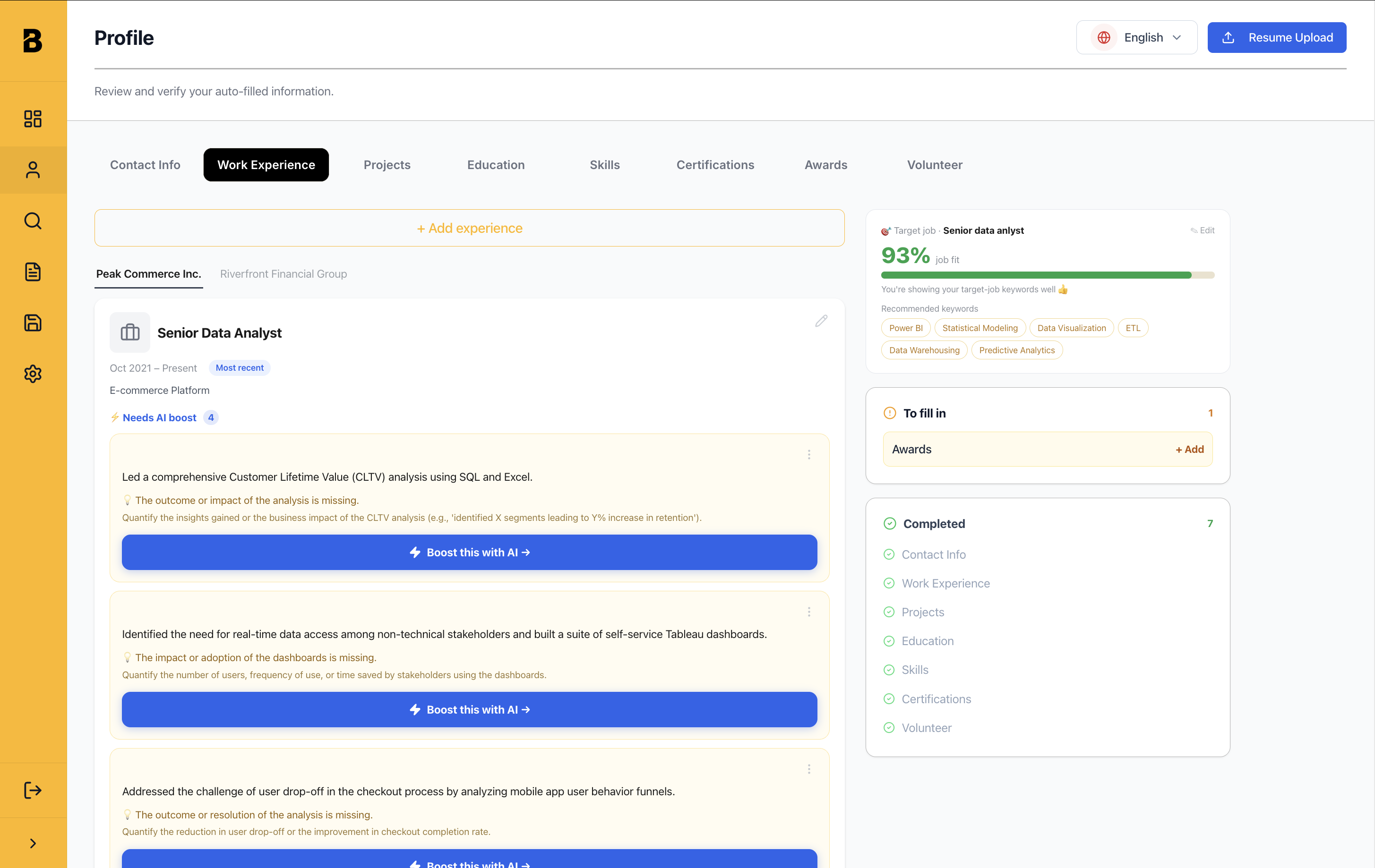
Case: profile has Senior Data Analyst experience; target is Data Analyst at a Series C SaaS company. Fit 93%. The three missing terms (Power BI · ETL · ML) surface immediately.
What to do: don't dump keywords into a Skills wall — the ATS 2.0 will flag it as stuffing. Instead, weave them into your existing bullets where they honestly apply. The Boost this with AI → action in the product does this rewrite automatically, preserving your real numbers and adding the missing terms in genuine context.
Timeline: 30 minutes to 2 hours. Small gaps close in an afternoon.
Large gap, role-level (fit 17%)
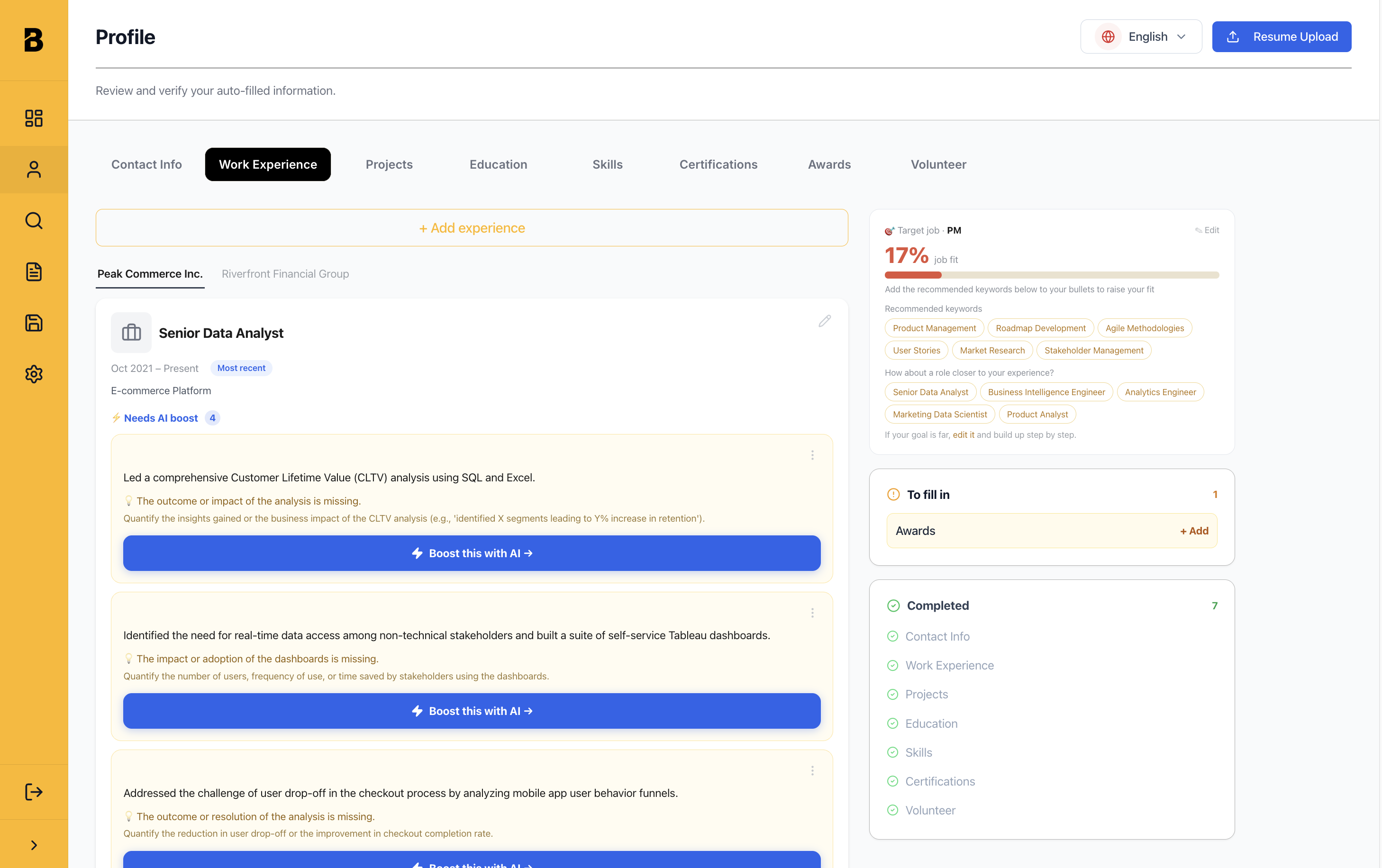
Same profile targeting Product Manager: fit 17%. The gap isn't three keywords — it's fundamental experience patterns (owning outcomes, cross-functional coordination, ambiguous scope).
What the tool surfaces: alternative roles where the same experience scores much higher. In this case: BI Engineer · Analytics Engineer · Product Analyst — all "adjacent" roles that use the existing analytical work directly. Some of these adjacent roles are also natural stepping stones toward PM if that remains the eventual goal.
Two paths:
- Reset to the higher-fit adjacent role (Product Analyst or Analytics Engineer). Apply immediately with a stronger profile match. Build PM-adjacent experience in the role.
- Keep PM as a 12-18 month build target. Ship product-adjacent work, run a real project end-to-end, own a metric outside your current job.
Either is valid. The mistake is applying to PM roles for 12 months with a 17% fit profile — the market signal is already clear.
4. Bridge Strategies for Large Gaps
If your target-role fit is under 40%, brute-force applying rarely converts. Three bridge patterns work:
- Adjacent-role first. Take the highest-fit alternative role that touches your target's core skills. One year in, apply to the target — you'll have real experience patterns to point to. Example: Data Analyst → Product Analyst → PM at 2-3 years.
- Internal transfer path. Join a company you'd want as a PM at (or Marketer at, or Designer at) in whatever role you can enter, then transfer internally. Internal transfers evaluate on adjacent-team work + track record, not a 5-JD external filter. This is often the fastest 2-year path.
- Portfolio project route. Ship 2-3 substantive projects in your target domain, publicly, with real users or real metrics. This works well for design, engineering, data, and increasingly PM. Doesn't work for sales (which needs actual deal experience) or highly-regulated fields.
Bootcamp certs and MOOCs alone rarely close a role-level gap. They can support a bridge strategy (a Data Engineering cert plus a live pipeline you built and open-sourced plus an adjacent-role position) but not substitute for real work.
5. Five Common Mistakes That Make Gap Analysis Worse Than Nothing
① Analyzing JDs from the wrong seniority. Pulling Senior PM JDs when applying entry-level makes every gap look 🔴 red — you'll close nothing because the requirements aren't for you. Match seniority tightly (APM ↔ APM JDs, not APM ↔ Senior PM JDs).
② Including "nice-to-have" as must-have. Postings label preferred/bonus for a reason. Treating 3-4 nice-to-have items as gates blows up your close list to unrealistic length. Only requirements marked as required (or that appear in 4-5/5 JDs) are true gates.
③ Analyzing 2-3 JDs, not 5. Under 5 JDs, noise contaminates the signal. One posting with an idiosyncratic tech-stack requirement will look like a must-have when it's actually specific to that one team.
④ Ignoring the "role fit" surface. If your current bullet library scores below 40% on your stated target but scores 75% on an adjacent role you hadn't considered, that's a signal — not a failure. Adjacent roles worth entering can still lead to the original target within 1-2 years.
⑤ Not re-running quarterly. Gap analysis is a snapshot. Six months of new experience, one shipped project, or a market shift (AI/LLM keywords in PM JDs since 2024) can change what's a gap. Re-run every quarter with fresh JDs.
Automating the Repetitive Work
Gap analysis operationalizes across the four Bullets tools:
- Bullet Creator — Master library of your quantified accomplishments. The target-role matching feature runs the ✅🟡❌ inventory automatically against any role, surfaces the role-fit % and adjacent roles.
- JD Clipper (Chrome extension) — Save 5 target JDs with one click each; ATS-optimized keywords extracted by weight. Cross-references across the 5 to surface the true must-haves.
- Resume Generator — Once your close list is done and gaps closed, matches saved postings against your master bullets and assembles the company-tailored resume as X-Y-Z impact bullets.
- Cover Letter Generator — Drops in the company's homepage URL; scanner reads six categories of company signal and drafts a cover letter as an achievement-led 4-part narrative (result → context → action → value, 15/20/50/15%).
Quarterly cadence: re-inventory the library → run target-role matching against your current targets → surface new gaps → close → re-apply.
Start with Bullet Creator → — inventory takes 15 minutes if you already have bullets; an afternoon if you're starting fresh.
Where this fits
Baseline: Entry-Level Resume · What is ATS in 2026. Next: Bullet Quantification 101 · ATS 7 Rules 2026 · Hidden Metrics by Job Role.
Sources: Global entry-level offer rate data from LinkedIn talent insights and Handshake 2024-2025 hiring reports (~1-2% cold-apply conversion, ~10% ceiling), Bullet Creator's target-role matching methodology.
Tagged with
Comments
0 comments
No comments yet. Be the first to comment!
Ready to build your resume?
Bullets — Tailored resumes and cover letters, faster.